Read the passage carefully and answer the questions.
Carboxylic acids are the organic compounds which comprise of carboxyl functional group, -COOH. These are generally found in nature, some higher members are known as fatty acids as they occur in natural fats as esters of glycerol. They can be prepared from oxidation of alcohols and aldehydes, hydrolysis of nitriles and amides and Grignard reagents. They are stronger acids than simple phenols and alcohols. but weaker than mineral acids. Substituents affect the acidity of aliphatic and aromatic carboxylic acids. They undergo reactions involving cleavage of -OH and C-OH bond. Carboxylic acids having an alpha hydrogen get halogenated in the presence of red phosphorus to form alpha halo carboxylic acids. The reaction is known as Hell Volhard Zelinsky reaction. Besides these aromatic carboxylic acids undergo electrophilic substitution reactions. They are versatile and are employed in the manufacture of various useful compounds. For example, methanoic acid is used in rubber, textile, dyeing, leather and electroplating industries. Higher fatty acids are used in the manufacture of soaps and detergents. Esters of Benzoic acid are used in perfumery.
The reagents needed for the preparation of Benzoic acid from ethyl benzene is
Answer & explanation
Correct answer: option 2
The correct answer is Option (2) → \(KMnO_4-KOH, H_3O^+\)
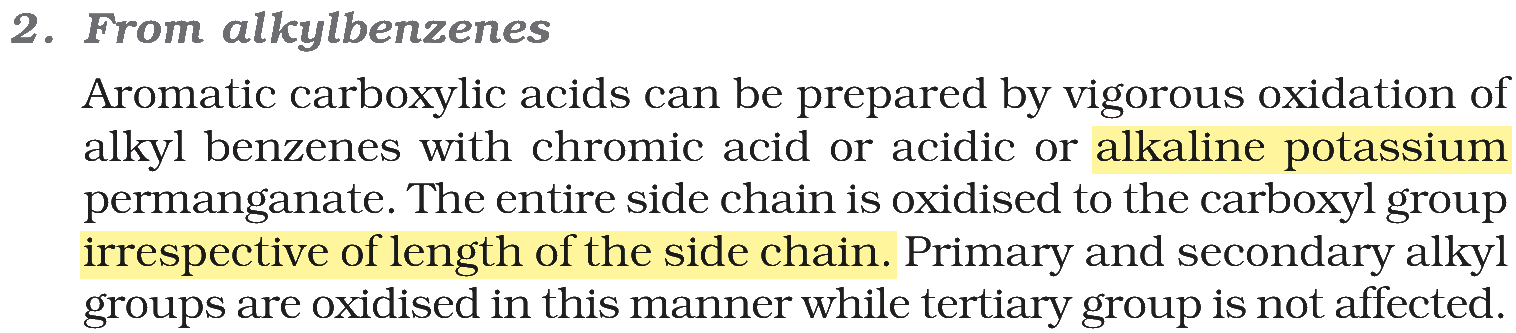
Aromatic carboxylic acids are made by vigorous oxidation of alkylbenzenes with alkaline (or acidic) potassium permanganate or chromic acid. The whole side chain is oxidised to –COOH, whatever its length, as long as the carbon attached to the ring carries a hydrogen.
Ethylbenzene is heated with alkaline \( \ce{KMnO4} \). The ethyl group is oxidised to a carboxylate group (its second carbon is lost as \( \ce{CO2} \)), giving potassium benzoate. Acidification with \( \ce{H3O+} \) then frees benzoic acid:
\( \displaystyle \ce{C6H5CH2CH3} \xrightarrow[\text{heat}]{\ce{KMnO4}\text{-}\ce{KOH}} \ce{C6H5COO^-K^+} \xrightarrow{\ce{H3O+}} \ce{C6H5COOH} \)
So the reagents are \( \ce{KMnO4} \)–KOH followed by \( \ce{H3O+} \).
Why the other options are incorrect
Option (1) \(AgNO_3/H_2SO_4\) — Incorrect. Silver nitrate is not an oxidising agent for side chains; it does not convert an alkyl group into –COOH.
Option (3) \(H_2/PtO_2\) — Incorrect. This is a catalytic hydrogenation; it adds hydrogen and would reduce the ring to ethylcyclohexane instead of oxidising the side chain.
Option (4) \(LiAlH_4/Ether\) — Incorrect. Lithium aluminium hydride is a reducing agent (it reduces acids to alcohols); it does not react with ethylbenzene.
NCERT (2026-27 edition):
From Alkylbenzenes