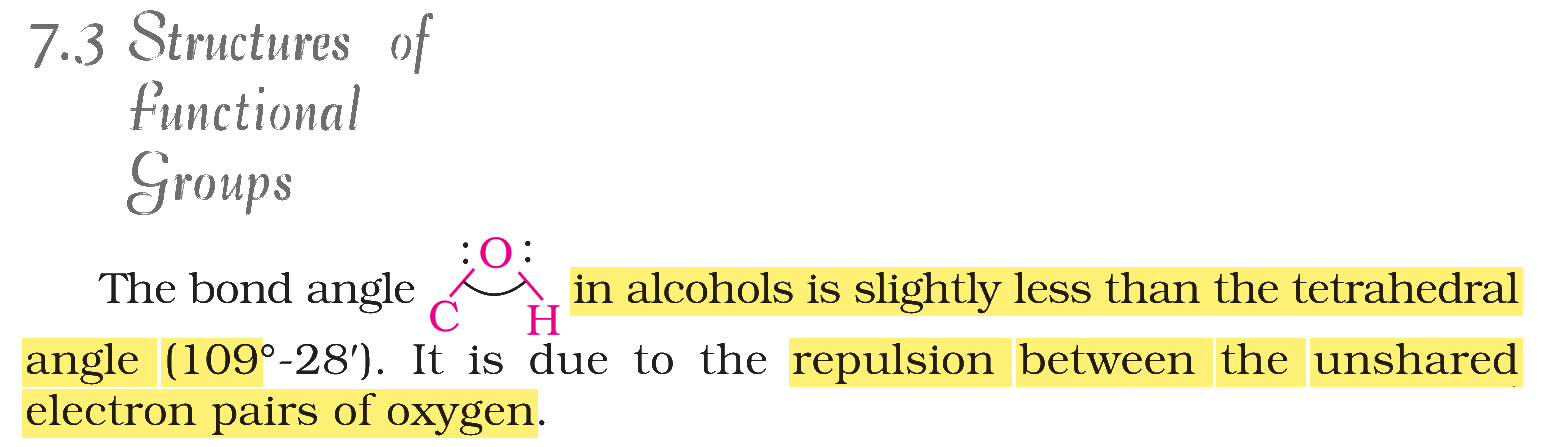
How does the C–O–H bond angle in alcohols compare with the tetrahedral angle (109°28′)?
Answer & explanation
Correct answer: option 1
The correct answer is Option (1) → Slightly less than 109°28′
The oxygen of an alcohol is sp3 hybridised, with two bond pairs and two lone pairs. The repulsion between these unshared electron pairs is stronger than that between bond pairs, so the C–O and O–H bonds are pushed closer together and the C–O–H angle becomes slightly less than the tetrahedral angle.
Why the other options are incorrect
Option (2) Equal to 109°28′ — Incorrect. This would need all four electron pairs to repel equally; the lone pairs repel more and squeeze the angle.
Option (3) Slightly greater than 109°28′ — Incorrect. This is true of the C–O–C angle in ethers, where two bulky alkyl groups repel each other.
Option (4) Equal to 120° — Incorrect. 120° is the angle of a trigonal planar (sp2) centre; the oxygen of an alcohol is sp3.
NCERT (2026-27 edition):
7.3 Structures of Functional Groups