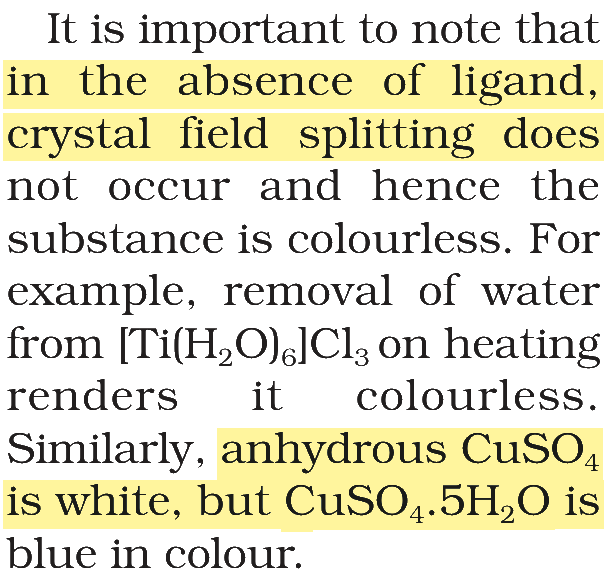
\( \text{CuSO}_4 \) is colorless but \( \text{CuSO}_4\text{.5H}_2\text{O} \) is blue in color. Which of the following statements is incorrect about the color of \( \text{CuSO}_4\text{.5H}_2\text{O} \)?
Answer & explanation
Correct answer: option 3
The correct answer is Option (3) → presence of \( \text{ SO}_4^{2-}\) ion in coordination sphere imparts the color of \(\text{CuSO}_4\text{.5H}_2\text{O} \)
Transition metal complexes are coloured because of d–d transitions. The ligands split the d orbitals of the metal ion into two sets of different energy (crystal field splitting). An electron in the lower set absorbs visible light and jumps to the upper set, and the complex shows the complementary colour. Without ligands there is no splitting, and no colour.
Cu (Z = 29) is \( \mathrm{[Ar]\,3d^{10}\,4s^{1}} \); losing the 4s electron and one 3d electron gives \( \ce{Cu^2+} \): \( \mathrm{3d^{9}} \), which has a vacancy for a d–d transition. In blue vitriol, four water molecules are the ligands around \( \ce{Cu^2+} \), \( \ce{[Cu(H2O)4]SO4.H2O} \). Anhydrous \( \ce{CuSO4} \) has no water ligands and is white.
Option (1) in \(\text{CuSO}_4\text{.5H}_2\text{O} \) water act as ligand — Correct about the colour. Four of the five water molecules are bonded to \( \ce{Cu^2+} \) through oxygen lone pairs; the fifth is held by hydrogen bonds.
Option (2) crystal field splitting takes place in \(\text{CuSO}_4\text{.5H}_2\text{O} \) — Correct about the colour. The water ligands split the 3d orbitals of \( \ce{Cu^2+} \).
Option (3) presence of \( \text{ SO}_4^{2-}\) ion in coordination sphere imparts the color of \(\text{CuSO}_4\text{.5H}_2\text{O} \) — Incorrect about the colour. The sulphate ion is the counter ion outside the coordination sphere. The colour comes from the water ligands around \( \ce{Cu^2+} \), which absorb light in the red-orange region, so the crystal looks blue.
Option (4) \(d-d\) transition takes place in \(\text{CuSO}_4\text{.5H}_2\text{O} \) — Correct about the colour. The 3d9 ion absorbs visible light by a d–d transition, which gives the blue colour.
NCERT (2026-27 edition):
Colour in Coordination Compounds – …