
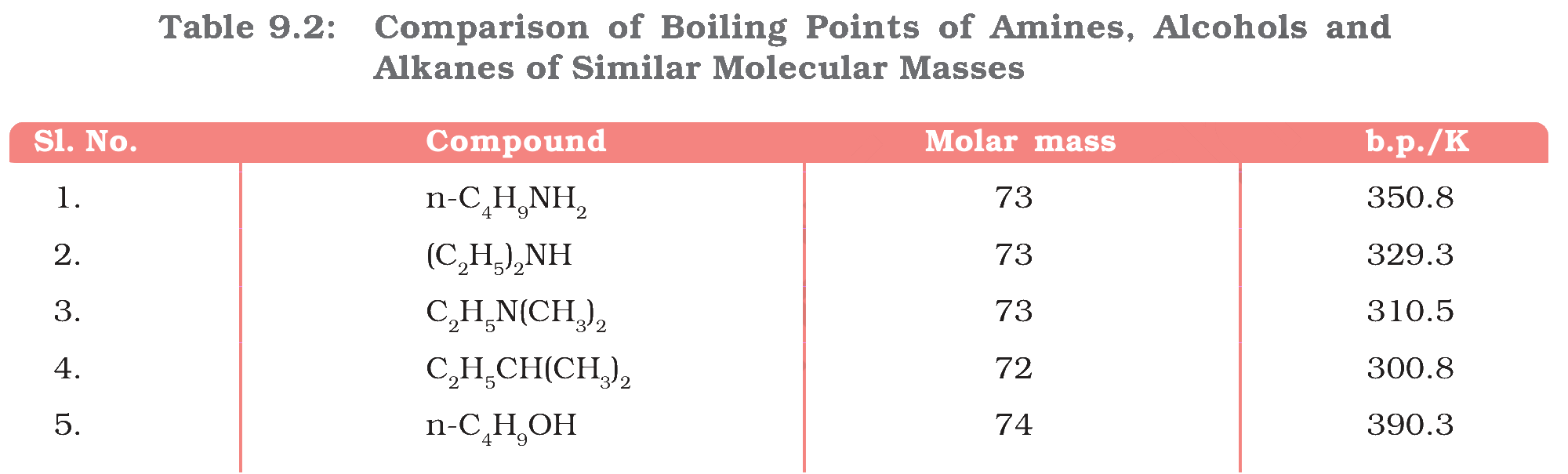
The table compares the boiling points of some amines, an alcohol and an alkane of similar molecular masses.
Which compound in the table has the highest boiling point, and what is the reason?
Answer & explanation
Correct answer: option 4
The correct answer is Option (4) → n-C4H9OH; alcohols are more polar than amines and form stronger intermolecular hydrogen bonds
The table gives the highest boiling point, 390.3 K, for n-C4H9OH; the primary amine n-C4H9NH2 comes next at 350.8 K. The molar masses are almost the same (72–74), so the difference comes from intermolecular hydrogen bonding.
Oxygen (electronegativity 3.5) is more electronegative than nitrogen (3.0), so the O–H bond is more polar than the N–H bond. The alcohol therefore forms stronger hydrogen bonds and boils highest.
Why the other options are incorrect
Option (1) n-C4H9NH2; it has two N–H hydrogens and so forms more hydrogen bonds than the alcohol — Incorrect. The table puts n-C4H9NH2 (350.8 K) below n-C4H9OH (390.3 K); its hydrogen bonds are weaker than those of the alcohol.
Option (2) n-C4H9OH; it has the highest molar mass in the table — Incorrect. The compound is right, but its molar mass, 74, is almost the same as the others (72–73); a difference of one unit cannot explain a boiling point about 40 K above the amine.
Option (3) n-C4H9NH2; the N–H bond is more polar than the O–H bond — Incorrect. The amine is not the highest-boiling compound, and the O–H bond is the more polar one, because oxygen is more electronegative than nitrogen.
NCERT (2026-27 edition):
9.5 Physical Properties – “… alcohols are more polar than amines and form stronger intermolecular hydrogen bonds than amines.”
“Boiling points of amines, alcohols and alkanes of almost the same molar mass are shown in Table 9.2.”
Table 9.2: Comparison of Boiling Points of Amines, Alcohols and Alkanes of Similar Molecular Masses