CUETMOCK
  • Pricing
  • Mentors
Log inStart freeStart free mocks→

First test, then trust

Try a free CUET mock test.

Join 5,00,000+ students who rehearsed exam day on the exact NTA screen before sitting CUET. On the web and on Android.

Start free mocks →Get the Android app
CUETMOCK

India's #1 CUET Mock Test Platform. Original NCERT-based questions on the exact NTA exam screen — trusted by 5,00,000+ students since CUET 2022.

Get it onGoogle PlayScan to download the CUETMOCK app

Mock tests

  • CUET mock test series
  • Browse all papers
  • Commerce mocks
  • Humanities (Arts) mocks
  • Science mocks
  • Languages & GAT mocks
  • Free practice questions
  • Pricing

Resources

  • CUET exam guide
  • CUET syllabus
  • Universities accepting CUET
  • Expert blogs
  • News & notifications
  • Webinars & counselling
  • CUET score calculator
  • How we estimate your rank
  • FAQs

Company

  • About us
  • Our leadership & team
  • Our toppers
  • Mentors
  • For schools
  • Contact us
  • Terms
  • Privacy
  • Refund policy

Talk to us

+91 7696 6630 56info@cuetmock.comWhatsApp us

Our other platforms

  • JEE Mock — For IIT-JEE aspirants
  • NEET Mock — For NEET aspirants

Newsletter

Exam updates, study material and offers — no spam.

© 2026 NYC Ventures Pvt. Ltd.

701-702, Royal Business Park, Zirakpur, Punjab - 140603

  • Terms of use
  • Privacy policy
  • Refund policy
  • Contact us

iCUETMOCK is an independent preparation platform, not affiliated with the National Testing Agency (NTA). Always check exam details on the official NTA website.

  • Home
  • Mock tests
  • CUET guide
  • Pricing
  • Log in
Home/Practice questions/Economics
EconomicsMicro Economics: Production and Costs

What are the values of marginal product and average product, when cha…

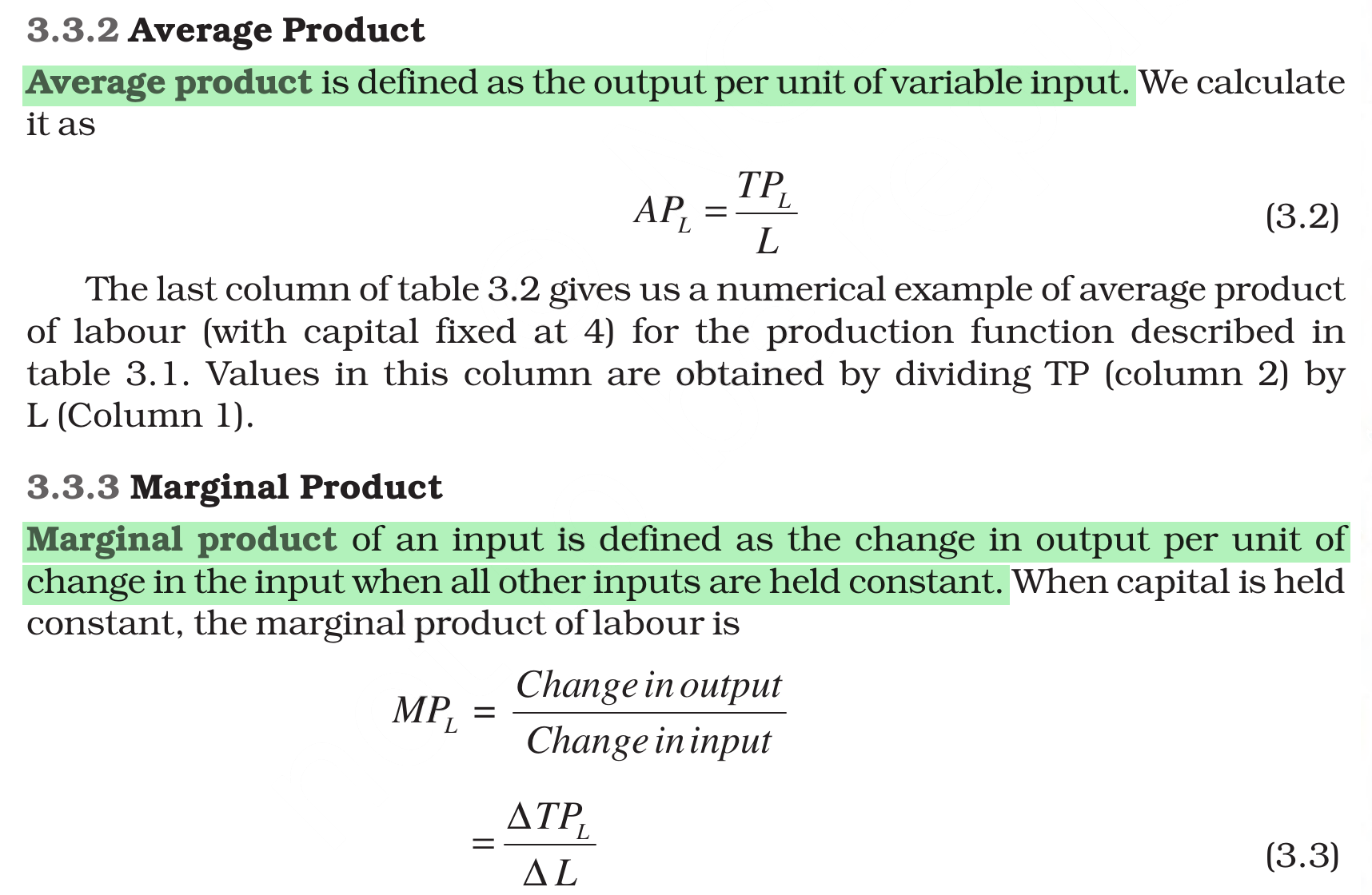
What are the values of marginal product and average product, when changes in labour from 3 to 4 which leads to changes in total product from 40 to 50?

Answer & explanation+

Correct answer: option 1

The correct answer is Option (1) → 10 and 12.5

When one more worker is added, output rises, and that rise per unit of labour is the marginal product. If instead the whole output is shared equally among the workers, we get output per worker, the average product.

Given:

  • Labour rises from 3 to 4 units, so ΔL = 1

  • Total product rises from 40 to 50, so ΔTP = 10

Working it out:

  • MP = ΔTP ÷ ΔL = 10 ÷ 1 = 10

  • AP = TP ÷ L = 50 ÷ 4 = 12.5, so the values are 10 and 12.5, Option (1)

  • Dividing 40 by 3 gives 13.33, the average product at 3 units, before the change; after it, with 4 units, the average product is 12.5.


NCERT: Introductory Microeconomics — Chapter 3: Production and Costs (2025-26)

NCERT extract

Advertisement

Practise more on Micro Economics: Production and Costs

Chapter-wise mocks on the real NTA exam screen, with solutions and your rank. Your first mocks are free.

Start free mocks →

Advertisement

Next questions

  1. Select the most appropriate antonym to the underlined word in the sentence given below:The judge appreciated the young speaker for his IMMA…English · Antonyms
  2. Cultivators revolted against the British because:History · Modern India: Rebels and the Raj
  3. Country X holds its currency at a fixed rate but its reserves of foreign exchange are small, and it often runs BoP deficits. Country Y lets…Economics · Macro Economics: Open Economy Macro Economics
  4. Consider the following statements:(A) The order of a reaction can be known from experimental results and not from the stoichiometry of the…Chemistry · Physical: Chemical Kinetics
  5. The de Broglie wavelength and the kinetic energy of a particle are 2000 Å and 1 eV respectively. If its kinetic energy becomes 1 MeV, its d…Physics · Dual Nature of Radiation and Matter
  6. After a change in government rules, the shareholders of Omega Ltd. now keep less from each rupee of dividend than from each rupee of capita…Business Studies · Financial Management
  7. The value of the determinant […] isMaths. Section A · Determinants (Section A)
  8. The point on the line r = (imath+2k)+λ(imath+jmath-k) which is equidistant from the points A(3, 0, 2) and B(1, 2, 4) isMaths. Section B1 · Three-dimensional Geometry
  9. What is the role of the metal catalyst (such as nickel) in catalytic hydrogenation?Chemistry · Organic: Alcohols, Phenols and Ethers
  10. Shifting cultivation is known as “Milpa” in which of the following regions?General Aptitude Test · General Knowledge