CUETMOCK
  • Pricing
  • Mentors
Log inStart freeStart free mocks→

First test, then trust

Try a free CUET mock test.

Join 5,00,000+ students who rehearsed exam day on the exact NTA screen before sitting CUET. On the web and on Android.

Start free mocks →Get the Android app
CUETMOCK

India's #1 CUET Mock Test Platform. Original NCERT-based questions on the exact NTA exam screen — trusted by 5,00,000+ students since CUET 2022.

Get it onGoogle PlayScan to download the CUETMOCK app

Mock tests

  • CUET mock test series
  • Commerce mocks
  • Humanities (Arts) mocks
  • Science mocks
  • Languages & GAT mocks
  • Free practice questions
  • Pricing

Resources

  • CUET exam guide
  • CUET syllabus
  • Universities accepting CUET
  • Expert blogs
  • News & notifications
  • Webinars & counselling
  • CUET score calculator
  • How we estimate your rank
  • FAQs

Company

  • About us
  • Our leadership & team
  • Our toppers
  • Mentors
  • For schools
  • Contact us
  • Terms
  • Privacy
  • Refund policy

Talk to us

+91 7696 6630 56info@cuetmock.comWhatsApp us

Our other platforms

  • JEE Mock — For IIT-JEE aspirants
  • NEET Mock — For NEET aspirants

Newsletter

Exam updates, study material and offers — no spam.

© 2026 NYC Ventures Pvt. Ltd.

701-702, Royal Business Park, Zirakpur, Punjab - 140603

  • Terms of use
  • Privacy policy
  • Refund policy
  • Contact us

iCUETMOCK is an independent preparation platform, not affiliated with the National Testing Agency (NTA). Always check exam details on the official NTA website.

  • Home
  • Mock tests
  • CUET guide
  • Pricing
  • Log in
Home/Practice questions/Geography
GeographyFundamentals of Human Geography: World Population-Distribution, Density and growth

Match List-I with List-IIList-I(Demographic Transition Stage)List-II(…

Match List-I with List-II

List-I
(Demographic Transition Stage)
List-II
(Country)
(A)Stage I(I)India (During 1951 to 1971)
(B)Stage II (Early)(II)Rainforest tribe
(C)Stage II (Late)(III)Japan
(D)Stage III(IV)Kenya

Choose the correct answer from the options given below:

Answer & explanation+

Correct answer: option 2

The correct answer is Option (2) → (A) - (II), (B) - (I), (C) - (IV), (D) - (III)

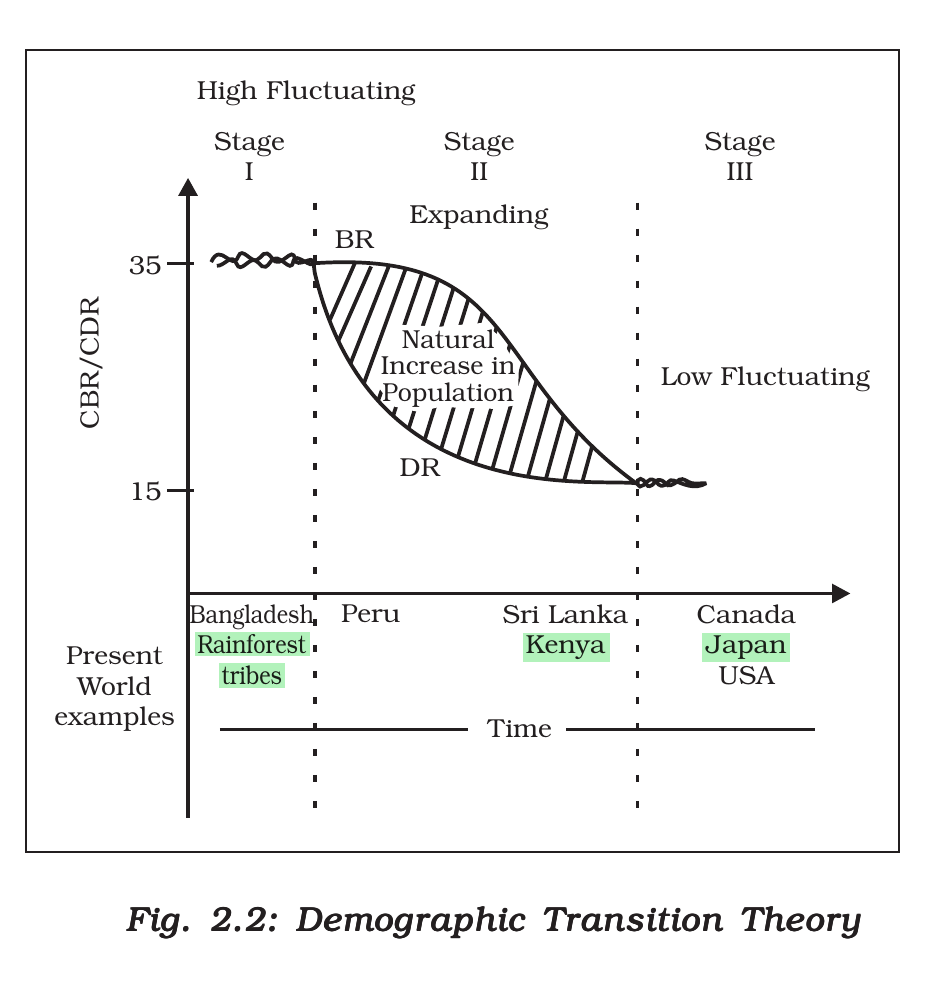
(A) Stage I — this matches (II) Rainforest tribe. The first stage has high fertility and high mortality, and the diagram gives rainforest tribes as a present-day example.

(B) Stage II (Early) — this matches (I) India (During 1951 to 1971). At the start of the second stage fertility is still high while mortality falls. In India the decades 1951-1981 were the period of population explosion, caused by a rapid fall in the death rate but a high birth rate.

(C) Stage II (Late) — this matches (IV) Kenya. Kenya is placed towards the end of the second stage in the diagram, where fertility has begun to decline.

(D) Stage III — this matches (III) Japan. In the last stage both fertility and mortality are low; Japan is given with Canada and the USA.

Note: The diagram of demographic transition in the current NCERT book (2025-26) names rainforest tribes, Kenya and Japan, but India (1951 to 1971) is not named in it. The book describes India’s growth in 1951-1981 as a rapid fall in mortality with high fertility, which is the early second stage; so the match follows, and the answer is marked as per the NTA answer key.


NCERT (2025-26): “DEMOGRAPHIC TRANSITION … … The first stage has high fertility and high mortality because people reproduce more to compensate for the deaths due to epidemics and variable food supply. The population growth is slow and most of the people are engaged in agriculture where large families are an asset. Life expectancy is low, people are mostly illiterate and have low levels of technology. Two hundred years ago all the countries of the world were in this stage.

Fertility remains high in the beginning of second stage but it declines with time. This is accompanied by reduced mortality rate. Improvements in sanitation and health conditions lead to decline in mortality. Because of this gap the net addition to population is high.…”

“DEMOGRAPHIC TRANSITION … In the last stage, both fertility and mortality decline considerably. The population is either stable or grows slowly. The population becomes urbanised, literate and has high technical know- how and deliberately controls the family size.…”

“Population: Distribution, Density, Growth and Composition – Growth of Population: … Phase III : The decades 1951-1981 are referred to as the period of population explosion in India, which was caused by a rapid fall in the mortality rate but a high fertility rate of population in the country.…”

NCERT extract

Advertisement

Practise more on Fundamentals of Human Geography: World Population-Distribution, Density and growth

Chapter-wise mocks on the real NTA exam screen, with solutions and your rank. Your first mocks are free.

Start free mocks →

Advertisement

Next questions

  1. Which of the following is not an advantage of the functional structure of organization?Business Studies · Organising
  2. When a conductor is placed in an external electric field,Physics · Electric Charges and Fields
  3. Match List-I with List-IIList-IList-IIEnzymesProducts/function(A) RNA polymerase I(I) tRNA, 5srRNA, and snRNAs(B) RNA polymerase III(II) rR…Biology · Molecular Basis of Inheritance
  4. The solution set of the inequality 3x+4ylt 12 isMaths. Section B1 · Linear Programming
  5. Arrange the following stages of human evolution in correct chronological order.(A) Australopithecines(B) Homo erectus(C) Ramapithecus(D) Ho…Biology · Evolution
  6. Which of the following types of issue of shares is allowed to a company?(A) Issue of shares of Face Value Rs. 10 at Rs. 11 by Initial Publi…Accountancy Part A · Accounting for Shares
  7. The financial statements of a business enterprise does not include:Accountancy Part B · Financial Statements of a Company
  8. Choose the idiom that conveys the sense that someone is deliberately creating trouble.English · Grammar: Idioms
  9. Select the most appropriate antonym to the underlined word in the sentence given below:The judge appreciated the young speaker for his IMMA…English · Antonyms
  10. Cultivators revolted against the British because:History · Modern India: Rebels and the Raj