
CUETMOCK
  • Pricing
  • Mentors
Log inStart freeStart free mocks→

First test, then trust

Try a free CUET mock test.

Join 5,00,000+ students who rehearsed exam day on the exact NTA screen before sitting CUET. On the web and on Android.

Start free mocks →Get the Android app
CUETMOCK

India's #1 CUET Mock Test Platform. Original NCERT-based questions on the exact NTA exam screen — trusted by 5,00,000+ students since CUET 2022.

Get it onGoogle PlayScan to download the CUETMOCK app

Mock tests

  • CUET mock test series
  • Commerce mocks
  • Humanities (Arts) mocks
  • Science mocks
  • Languages & GAT mocks
  • Free practice questions
  • Pricing

Resources

  • CUET exam guide
  • CUET syllabus
  • Universities accepting CUET
  • Expert blogs
  • News & notifications
  • Webinars & counselling
  • CUET score calculator
  • How we estimate your rank
  • FAQs

Company

  • About us
  • Our leadership & team
  • Our toppers
  • Mentors
  • For schools
  • Contact us
  • Terms
  • Privacy
  • Refund policy

Talk to us

+91 7696 6630 56info@cuetmock.comWhatsApp us

Our other platforms

  • JEE Mock — For IIT-JEE aspirants
  • NEET Mock — For NEET aspirants

Newsletter

Exam updates, study material and offers — no spam.

© 2026 NYC Ventures Pvt. Ltd.

701-702, Royal Business Park, Zirakpur, Punjab - 140603

  • Terms of use
  • Privacy policy
  • Refund policy
  • Contact us

iCUETMOCK is an independent preparation platform, not affiliated with the National Testing Agency (NTA). Always check exam details on the official NTA website.

  • Home
  • Mock tests
  • CUET guide
  • Pricing
  • Log in
Home/Practice questions/Chemistry
ChemistryInorganic: Coordination Compounds

Which of the following is a correct statement about [NiCl4]2− and [Ni…

Which of the following is a correct statement about [NiCl4]2− and [Ni(CO)4]?

Answer & explanation+

Correct answer: option 2

The correct answer is Option (2) → [NiCl4]2− is tetrahedral and paramagnetic whereas [Ni(CO)4] is tetrahedral and diamagnetic.

By valence bond theory, the shape of a four-coordinate complex depends on whether the ligands force the d electrons to pair:

  • sp3 hybridisation → tetrahedral: used when no inner d orbital is freed.

  • dsp2 hybridisation → square planar: used when a strong field ligand pairs the electrons and frees one 3d orbital.

The magnetic behaviour follows from the unpaired electrons left: any unpaired electron makes the complex paramagnetic; none makes it diamagnetic.

[NiCl4]2−: x + 4(−1) = −2, so nickel is +2. Ni (Z = 28) is [Ar]3d84s2; losing the two 4s electrons gives \( \ce{Ni^{2+}} \): 3d8, three pairs and two single electrons in the five 3d orbitals. \( \ce{Cl^{-}} \) is a weak field ligand and cannot pair the electrons, so two electrons stay unpaired. The four \( \ce{Cl^{-}} \) ions use the 4s and 4p orbitals (sp3), so the complex is tetrahedral and paramagnetic.

[Ni(CO)4]: CO is neutral, so nickel is in the zero oxidation state and has the configuration of the Ni atom, [Ar]3d84s2. The strong field CO ligands push the 4s electrons into 3d, giving 3d10 with no unpaired electron. The empty 4s and 4p orbitals give sp3 hybridisation, so the complex is tetrahedral and diamagnetic.

Why the other options are incorrect

  • Option (1) [NiCl4]2− is tetrahedral and paramagnetic whereas [Ni(CO)4] is also tetrahedral and paramagnetic. — Incorrect. \( \ce{[Ni(CO)4]} \) has a 3d10 configuration with no unpaired electron, so it is diamagnetic.

  • Option (3) [NiCl4]2− is square planar and diamagnetic whereas [Ni(CO)4] is tetrahedral and diamagnetic. — Incorrect. Square planar and diamagnetic describes [Ni(CN)4]2−, where the strong field \( \ce{CN^{-}} \) pairs the electrons; weak field \( \ce{Cl^{-}} \) cannot do this.

  • Option (4) [NiCl4]2− is square planar and diamagnetic whereas [Ni(CO)4] is also square planar and diamagnetic. — Incorrect. Neither complex is square planar; \( \ce{[Ni(CO)4]} \) has no empty 3d orbital for dsp2 hybridisation.

NCERT (2026-27 edition):
Valence Bond Theory – …
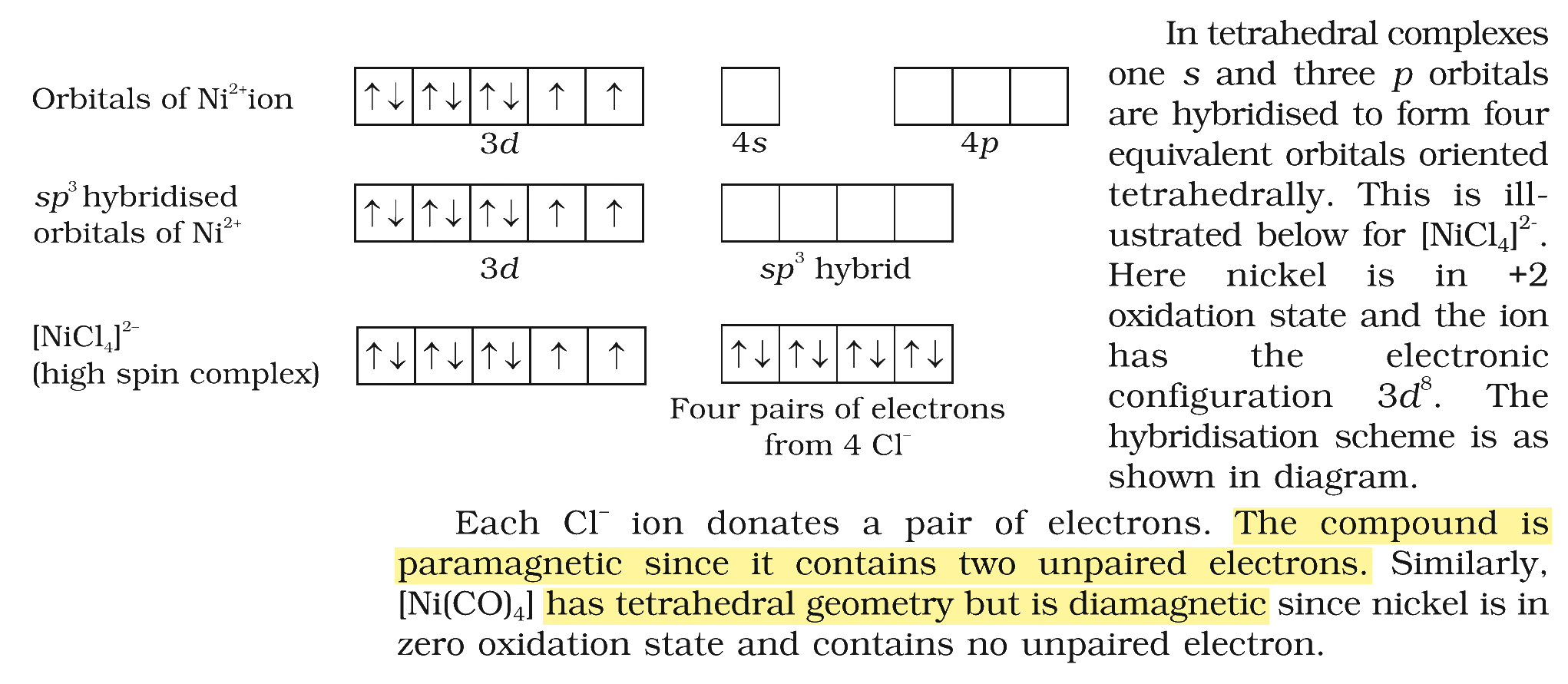
Textbook extract

Advertisement

Practise more on Inorganic: Coordination Compounds

Chapter-wise mocks on the real NTA exam screen, with solutions and your rank. Your first mocks are free.

Start free mocks →

Advertisement

Next questions

  1. A simple random sample of 50 items from a population with σ=6 resulted in a sample mean of 32. If the margin of error is 1.66, then the 95%…Applied Maths. Section B2 · Inferential Statistics
  2. At temperature 25\ ^°C , the resistance of a heating element is 100\ Ω . What is the temperature of the element, if the resistance is found…Physics · Current Electricity
  3. X Limited forfeited a share of Rs. 10 on which Rs. 8 is called-up and Rs. 6 is paid and forfeited. By what amount, share capital account wi…Accountancy Part A · Accounting for Shares
  4. Identify the factors that influence attitude formation.(A) Family and School Environment(B) Message Characteristics(C) Personal Experiences…Psychology · Attitudes and Social Cognition
  5. The solution of the differential equation 9+y^2displaystyledy/dx=x^2 is :[where C is an arbitrary constant]Applied Maths. Section A · Differential Equations (Section A)
  6. Match List-I (Name reaction) with List-II corresponding substrates.LIST-IName ReactionLIST-IISubstratesA.Carbylamine reactionI.RCONH2 + Br2…Chemistry · Organic: Amines
  7. Identify the two reagents used to convert ethanol to butane.Chemistry · Organic: Haloalkanes and Haloarenes
  8. Choose the option that best replaces the underlined word without changing the meaning of the given sentence:There is a persistent need to r…English · Synonyms
  9. Which one of the following is not the alien invasive species?Biology · Biodiversity and Conservation
  10. In the state elections held along with the first Lok Sabha elections, the Congress won a majority of seats in all the states except which o…Political Science · Politics in India Since Independence: Era of one Party Dominance