
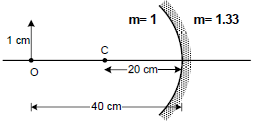
A point object is placed 40 cm in front of a spherical refracting surface of radius of curvature 20 cm that separates air (refractive index 1) from a medium of refractive index 4/3 (shown as 1.33 in the figure; m denotes the refractive index and C is the centre of curvature). Where is the image formed?
Answer & explanation
Correct answer: option 1
The correct answer is Option (1) → 32 cm from the surface, on the same side as the object (virtual)
For refraction at a spherical surface, the object distance \( u \) and the image distance \( v \) obey \( n_2/v-n_1/u=(n_2-n_1)/R \). We measure all distances from the surface and take the direction of the incident light as positive (Cartesian sign convention). From the figure, the centre of curvature C lies on the object side, so \( R \) is negative.
The data are:
\( u=-40\,\mathrm{cm} \)
\( R=-20\,\mathrm{cm} \)
\( n_1=1 \)
\( n_2=4/3 \)
Putting these in the refraction formula:
\( \begin{aligned} \frac{n_2}{v} &= \frac{n_2-n_1}{R}+\frac{n_1}{u} \\ &= \frac{4/3-1}{-20\,\mathrm{cm}}+\frac{1}{-40\,\mathrm{cm}} \\ &= -\frac{1}{60\,\mathrm{cm}}-\frac{1}{40\,\mathrm{cm}} \\ &= -\frac{1}{24\,\mathrm{cm}} \end{aligned} \)
\( \begin{aligned} v &= \frac{4}{3}\times(-24\,\mathrm{cm}) \\ &= -32\,\mathrm{cm} \end{aligned} \)
The negative sign means the image is on the same side as the object, 32 cm from the surface. The refracted rays do not actually meet there, so the image is virtual.