Match List-I (steps of the controlling process) with List-II (what a factory manager does):
| List-I | List-II | ||
|---|---|---|---|
| (A) | Setting performance standards | (I) | Finding that a worker made 180 units against the standard of 200 units for the week |
| (B) | Measurement of actual performance | (II) | Fixing an output of 200 units for each worker for every week |
| (C) | Comparing actual performance with standards | (III) | Finding that the shortfall came from a machine that kept breaking down |
| (D) | Analysing deviations | (IV) | Counting the units that each worker actually made during the week |
Choose the correct answer from the options given below:
Answer & explanation
Correct answer: option 1
The correct answer is Option (1) → (A)-(II), (B)-(IV), (C)-(I), (D)-(III)
| List-I | List-II | Reason |
|---|---|---|
| (A) Setting performance standards | (II) Fixing an output of 200 units for each worker for every week | Fixing the expected output gives the standard against which work will be checked. |
| (B) Measurement of actual performance | (IV) Counting the units that each worker actually made during the week | Counting the units made is measuring actual performance, in the same units as the standard. |
| (C) Comparing actual performance with standards | (I) Finding that a worker made 180 units against the standard of 200 units for the week | Setting 180 against 200 reveals the deviation of 20 units. |
| (D) Analysing deviations | (III) Finding that the shortfall came from a machine that kept breaking down | Finding why the shortfall happened is analysing the deviation for its cause. |
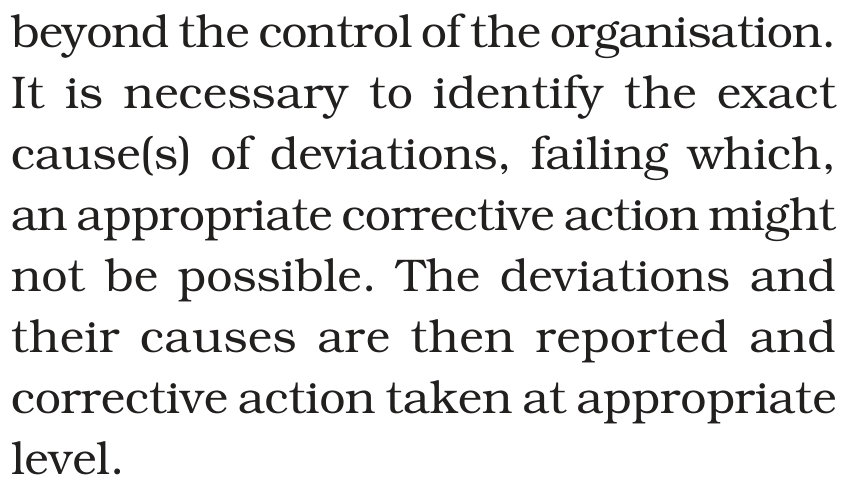
NCERT (2026-27 Edition):
|