
Read the passage and answer the following questions:
Mendel published his work on inheritance of characters in 1865 but for several reasons, it remained unrecognised till 1900. Firstly, communication was not easy (as it is now) in those days and his work could not be widely publicised. Secondly, his concept of genes (or factors, in Mendel's words) as stable and discrete units that controlled the expression of traits and, of the pair of alleles which did not 'blend' with each other, was not accepted by his contemporaries as an explanation for the apparently continuous variation seen in nature. Thirdly, Mendel's approach of using mathematics to explain biological phenomena was totally new and unacceptable to many of the biologists of his time. Finally, though Mendel's work suggested that factors (genes) were discrete units, he could not provide any physical proof for the existence of factors or say what they were made of.
Given below are two statements: one is labelled as Assertion (A) and the other is labelled as Reason (R).
Assertion (A): Experimental verification of the chromosomal theory of inheritance was done by Thomas Hunt Morgan and his colleagues.
Reason (R): In Drosophila melanogaster, the male and female flies are easily distinguishable.
In the light of the above statements, choose the most appropriate answer from the options given below:
Answer & explanation
Correct answer: option 2
The correct answer is Option (2) → Both (A) and (R) are true but (R) is not the correct explanation of (A).
Assertion (A): Experimental verification of the chromosomal theory of inheritance was done by Thomas Hunt Morgan and his colleagues. — True. A is about who tested the chromosomal theory by experiment. After Sutton and Boveri proposed it, Thomas Hunt Morgan and his colleagues verified it. Their work found the basis of the variation that sexual reproduction produces.
Reason (R): In Drosophila melanogaster, the male and female flies are easily distinguishable. — True. R is about one feature of the fruit fly. In Drosophila melanogaster there is a clear differentiation of the sexes, so males and females are easy to tell apart.
Why R does not explain A? R gives only one of the features that made Drosophila a suitable organism for Morgan’s studies. It explains the choice of the fly, not why the theory was verified or who verified it, so it is not the correct explanation of A.
NCERT Extract:
Chromosomal Theory of Inheritance – “… Following this synthesis of ideas, experimental verification of the chromosomal theory of inheritance by Thomas Hunt Morgan and his colleagues, led to discovering the basis for the variation that sexual reproduction produced. Morgan worked with the tiny fruit flies, Drosophila melanogaster (Figure 4.10), which were found very suitable for such studies. They could be grown on simple synthetic medium in the laboratory. They complete their life cycle in about two weeks, and a single mating could produce a large number of progeny flies. Also, there was a clear differentiation of the sexes – the male and female flies are easily distinguishable. Also, it has many types of hereditary variations that can be seen with low power microscopes.”
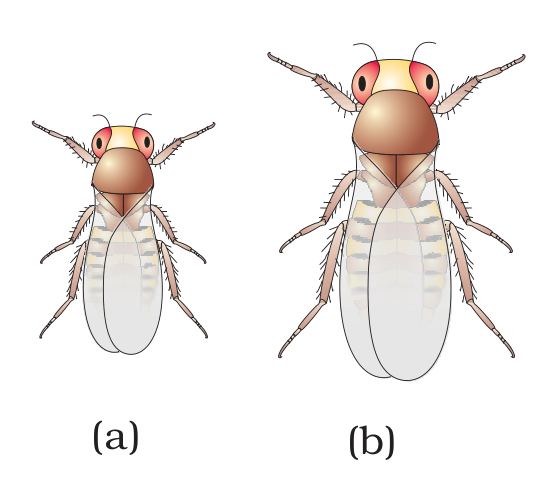
Figure 4.10 Drosophila melanogaster (a) Male (b) Female