CUETMOCK
  • Pricing
  • Mentors
Log inStart freeStart free mocks→

First test, then trust

Try a free CUET mock test.

Join 5,00,000+ students who rehearsed exam day on the exact NTA screen before sitting CUET. On the web and on Android.

Start free mocks →Get the Android app
CUETMOCK

India's #1 CUET Mock Test Platform. Original NCERT-based questions on the exact NTA exam screen — trusted by 5,00,000+ students since CUET 2022.

Get it onGoogle PlayScan to download the CUETMOCK app

Mock tests

  • CUET mock test series
  • Browse all papers
  • Commerce mocks
  • Humanities (Arts) mocks
  • Science mocks
  • Languages & GAT mocks
  • Free practice questions
  • Pricing

Resources

  • CUET exam guide
  • CUET syllabus
  • Universities accepting CUET
  • Expert blogs
  • News & notifications
  • Webinars & counselling
  • CUET score calculator
  • How we estimate your rank
  • FAQs

Company

  • About us
  • Our leadership & team
  • Our toppers
  • Mentors
  • For schools
  • Contact us
  • Terms
  • Privacy
  • Refund policy

Talk to us

+91 7696 6630 56info@cuetmock.comWhatsApp us

Our other platforms

  • JEE Mock — For IIT-JEE aspirants
  • NEET Mock — For NEET aspirants

Newsletter

Exam updates, study material and offers — no spam.

© 2026 NYC Ventures Pvt. Ltd.

701-702, Royal Business Park, Zirakpur, Punjab - 140603

  • Terms of use
  • Privacy policy
  • Refund policy
  • Contact us

iCUETMOCK is an independent preparation platform, not affiliated with the National Testing Agency (NTA). Always check exam details on the official NTA website.

  • Home
  • Mock tests
  • CUET guide
  • Pricing
  • Log in
Home/Practice questions/Economics
EconomicsMicro Economics: Production and Costs

Marginal Product of labour is inverse ‘U’-shaped because of :

Marginal Product of labour is inverse ‘U’-shaped because of :

Answer & explanation+

Correct answer: option 4

The correct answer is Option (4) → Law of Variable Proportions.

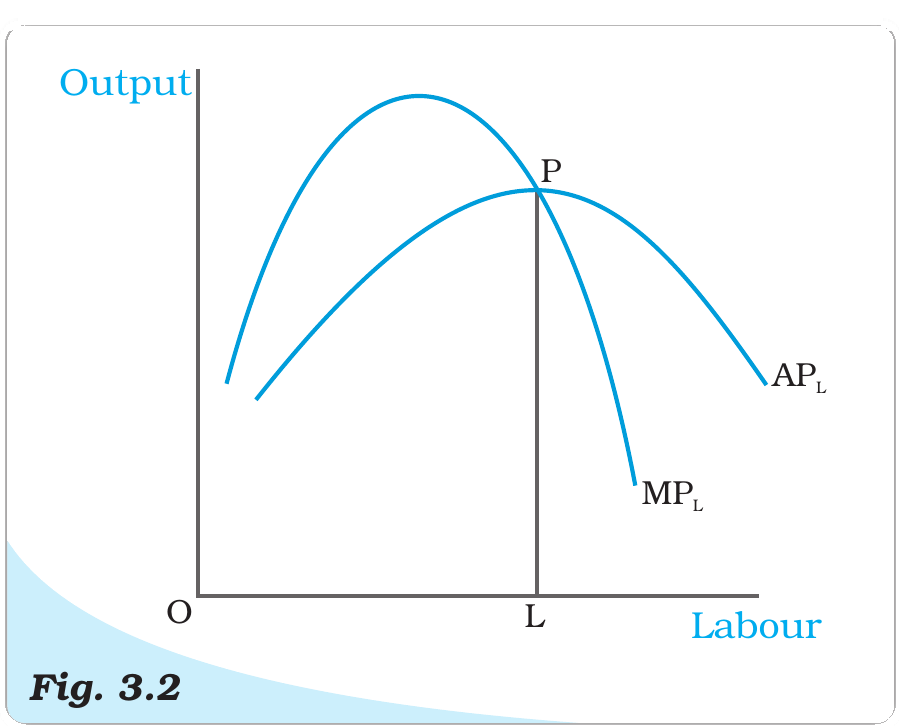
In the short run a firm has a fixed input, such as land, and raises output by adding a variable input, such as labour. The marginal product of labour (MP) is the extra output that one more worker adds. Add workers one by one to a fixed plot of land:

  • At first the land is under-used, so each new worker adds more than the one before: MP rises.

  • Later the land gets crowded; each worker has less land to work with and adds less than the one before: MP falls, and may even become negative.

MP therefore first rises and then falls, which gives its curve an inverse ‘U’ shape. This behaviour of output when one input is varied and the others are kept fixed is the Law of Variable Proportions.

Why the other options are incorrect

  • Option (1) Law of Diminishing Marginal utility. — Incorrect. This law belongs to consumer behaviour: the satisfaction from each additional unit of a good consumed falls. It describes utility, not the output of an input.

  • Option (2) Law of Marginal Rate of Substitution. — Incorrect. The marginal rate of substitution is the rate at which a consumer gives up one good for another along an indifference curve; its fall explains the shape of the indifference curve, not of the marginal product curve.

  • Option (3) Law of Demand. — Incorrect. The law of demand relates the price of a good to the quantity demanded by consumers; it has no bearing on production.


NCERT (2025-26): “3.4 The Law of Diminishing Marginal Product and the Law of Variable Proportions … Notice that the MP first increases (upto 3 units of labour) and then begins to fall. This tendency of the MP to first increase and then fall is called the law of variable proportions or the law of diminishing marginal product. Law of variable proportions say that the marginal product of a factor input initially rises with its employment level. But after reaching a certain level of employment, it starts falling. Why does this happen? In order to understand this, we first define the concept of factor proportions. Factor proportions represent the ratio in which the two inputs are combined to produce output. As we hold one factor fixed and keep increasing the other, the factor proportions change. Initially, as we increase the amount of the variable input, the factor proportions become more and more suitable for the production and marginal product increases. But after a certain level of employment, the production process becomes too crowded with the variable input.…

…According to the law of variable proportions, the marginal product of an input initially rises and then after a certain level of employment, it starts falling. The MP curve therefore, looks like an inverse ‘U’-shaped curve as in figure 3.2.…”

NCERT extract

Advertisement

Practise more on Micro Economics: Production and Costs

Chapter-wise mocks on the real NTA exam screen, with solutions and your rank. Your first mocks are free.

Start free mocks →

Advertisement

Next questions

  1. Match List-I with List-IIList-IOsmotic pressureList-IIProperties(A) van’t Hoff factor ‘i’(I) molar concentration of solution(B) The osmotic…Chemistry · Physical: Solutions
  2. Fill in the blank with the most appropriate option:It is almost a year since Kavya ______ her college in Bengaluru, but she still video-cal…English · Grammar: Tenses
  3. Match List-I with List-II.List-I(Amine and reagent)List-II(Observation)(A) Ethanamine with benzenesulphonyl chloride(I) No reaction takes p…Chemistry · Organic: Amines
  4. How does the electric field due to a point charge vary with the distance r from it? It is proportional toPhysics · Electric Charges and Fields
  5. 'संस्कृति' का विशेषण क्या है?Hindi · व्याकरण - विशेषण
  6. A point charge of -4×10^-9\ C is fixed in air. A charge of +3×10^-9\ C is brought from infinity to a point 12 cm from it. The work done by…Physics · Electrostatic Potential and Capacitance
  7. The larger part of India’s workforce is employed in the:Economics · Indian Economic Development: Employment - Growth, Informalisation and Other Issues
  8. State the order of payment to be followed on the dissolution of a firm:(A) To each partner proportionately what is due to him/her from the…Accountancy Part A · Dissolution of Partnership Firm
  9. Choose the most appropriate passive construction of the given sentence:Do not leave the spare gas cylinder near the stove while the burner…English · Grammar: Active Passive Voice
  10. A loan of Rs. 1,20,000 is taken at 12% per annum for 1 year, to be repaid in 12 equal monthly instalments. For the reducing balance method,…Applied Maths. Section B2 · Financial Mathematics