
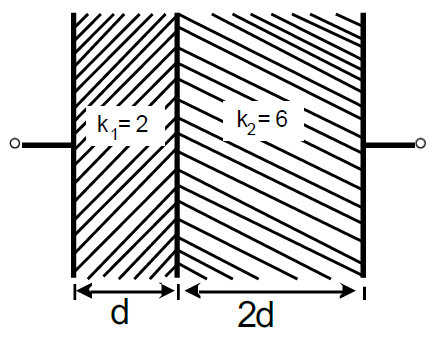
A parallel plate capacitor has two layers of dielectric, of dielectric constant 2 (thickness d) and 6 (thickness 2d), as shown in the figure. It is connected across a battery. The ratio of the potential difference across the layer of dielectric constant 2 to that across the layer of dielectric constant 6 is
Answer & explanation
Correct answer: option 4
The correct answer is Option (4) → 3/2
Two dielectric layers placed one after the other between the plates act as two capacitors in series. Each layer of thickness \( t \) and dielectric constant \( K \) has capacitance \( K\varepsilon_0A/t \). In series, both layers carry the same charge \( Q \). So the potential difference \( V=Q/C \) is larger across the layer of smaller capacitance.
From the figure, the layer with \( K=2 \) has thickness \( d \) and the layer with \( K=6 \) has thickness \( 2d \). Their capacitances are:
\( \displaystyle C_1=\frac{2\varepsilon_0A}{d} \)
\( \begin{aligned} C_2 &= \frac{6\varepsilon_0A}{2d} \\ &= \frac{3\varepsilon_0A}{d} \end{aligned} \)
With the same charge on both, the ratio of the potential differences is:
\( \begin{aligned} \frac{V_1}{V_2} &= \frac{Q/C_1}{Q/C_2} \\ &= \frac{C_2}{C_1} \\ &= \frac{3\varepsilon_0A/d}{2\varepsilon_0A/d} \\ &= \frac{3}{2} \end{aligned} \)