
CUETMOCK
  • Pricing
  • Mentors
Log inStart freeStart free mocks→

First test, then trust

Try a free CUET mock test.

Join 5,00,000+ students who rehearsed exam day on the exact NTA screen before sitting CUET. On the web and on Android.

Start free mocks →Get the Android app
CUETMOCK

India's #1 CUET Mock Test Platform. Original NCERT-based questions on the exact NTA exam screen — trusted by 5,00,000+ students since CUET 2022.

Get it onGoogle PlayScan to download the CUETMOCK app

Mock tests

  • CUET mock test series
  • Browse all papers
  • Commerce mocks
  • Humanities (Arts) mocks
  • Science mocks
  • Languages & GAT mocks
  • Free practice questions
  • Pricing

Resources

  • CUET exam guide
  • CUET syllabus
  • Universities accepting CUET
  • Expert blogs
  • News & notifications
  • Webinars & counselling
  • CUET score calculator
  • How we estimate your rank
  • FAQs

Company

  • About us
  • Our leadership & team
  • Our toppers
  • Mentors
  • For schools
  • Contact us
  • Terms
  • Privacy
  • Refund policy

Talk to us

+91 7696 6630 56info@cuetmock.comWhatsApp us

Our other platforms

  • JEE Mock — For IIT-JEE aspirants
  • NEET Mock — For NEET aspirants

Newsletter

Exam updates, study material and offers — no spam.

© 2026 NYC Ventures Pvt. Ltd.

701-702, Royal Business Park, Zirakpur, Punjab - 140603

  • Terms of use
  • Privacy policy
  • Refund policy
  • Contact us

iCUETMOCK is an independent preparation platform, not affiliated with the National Testing Agency (NTA). Always check exam details on the official NTA website.

  • Home
  • Mock tests
  • CUET guide
  • Pricing
  • Log in
Home/Practice questions/General Aptitude Test
General Aptitude TestNon-Verbal ReasoningComplete the pattern

Which of the option figures completes the given pattern?
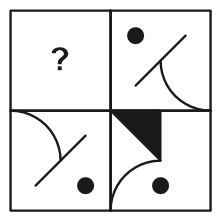
Which of the option figures completes the given pattern?

Problem figure

Answer & explanation+

Correct answer: option 4

The correct answer is Option (4) → 

The figure looks the same after a half turn about its centre: each quarter is the opposite quarter turned through 180°. So the missing top-left quarter is the bottom-right quarter turned through 180°.
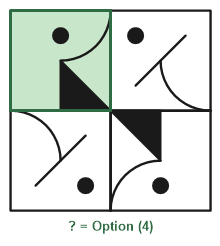
Figure for the solution

Why the other options are incorrect

  • Option (1) — Incorrect. This copies the bottom-right quarter as it is; the gap needs that quarter turned through 180°.

  • Option (2) — Incorrect. This is the correct piece turned through 90° anticlockwise.

  • Option (3) — Incorrect. The dot of the correct piece is missing.

Advertisement

Practise more on Non-Verbal Reasoning

Chapter-wise mocks on the real NTA exam screen, with solutions and your rank. Your first mocks are free.

Start free mocks →

Advertisement

Next questions

  1. Given below are two statements:Statement I: Among the types of malaria, malignant malaria caused by Plasmodium falciparum is the most serio…Biology · Human Health and Disease
  2. Which period of the modern periodic table is the shortest?General Aptitude Test · General Knowledge
  3. Assertion (A): Anilinium chloride is more acidic than ammonium chloride.Reason (R): Anilinium ion is more resonance stabilised than aniline.Chemistry · Organic: Amines
  4. Given below are two statements:Statement I: Outright open market operations are permanent, as the central bank buys or sells securities wit…Economics · Macro Economics: Money and Banking
  5. Choose the grammatically correct sentence:English · Sentence Correction
  6. In a formal letter, where is the subject line written?English · Formal/Informal Letters
  7. Select the word for the fear given below:A strong fear of being alone, or of lonely placesEnglish · Phobia
  8. Complete the sentences given in List-I with the appropriate words given in List-II.List-I (Sentences)List-II (Words)(A) From the muddy shoe…English · Homonyms
  9. Select the option that expresses the given sentence in direct speech.The hotel receptionist asked Varun if he had booked a room online.English · Direct/indirect
  10. What is the final product when phenylacetonitrile (C6H5CH2CN) is heated with dilute sulphuric acid?Chemistry · Organic: Aldehydes, Ketones and Carboxylic Acids