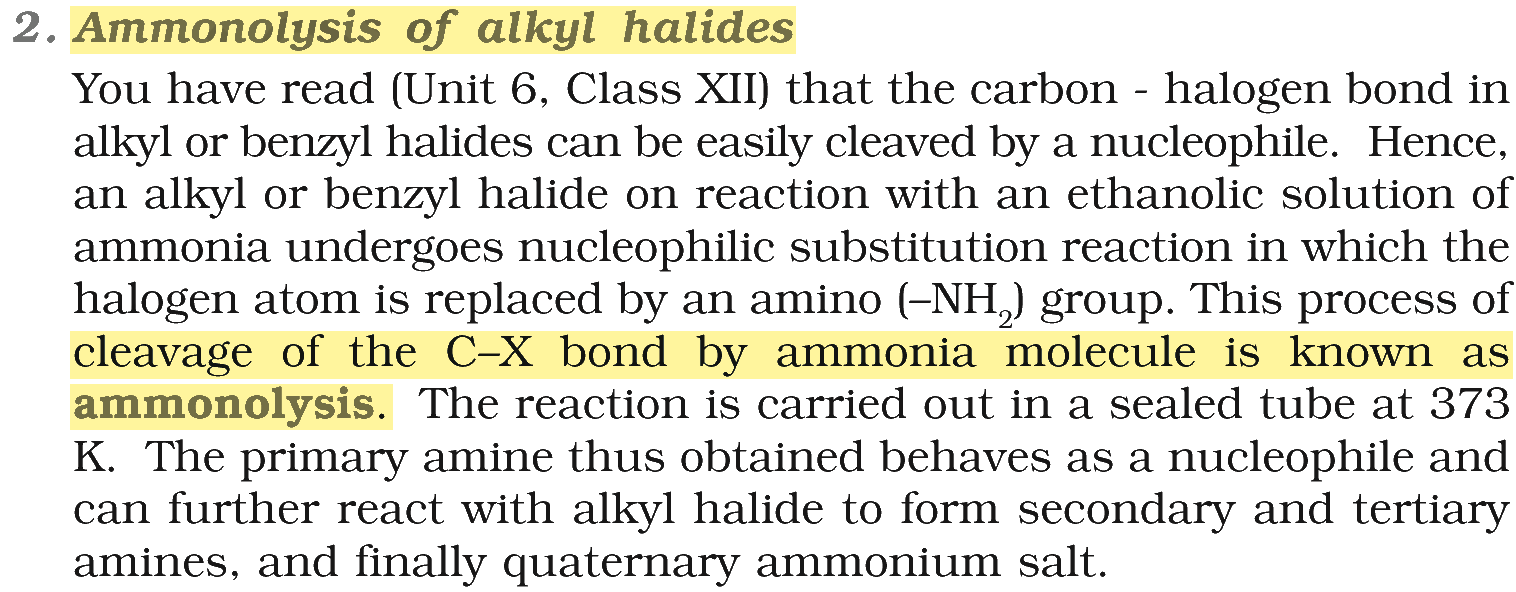
Ammonolysis process of alkyl halide involves
Answer & explanation
Correct answer: option 1
The correct answer is Option (1) → Cleavage of C-X bond
In ammonolysis, the nitrogen of ammonia uses its lone pair as a nucleophile and replaces the halogen, so the C–X bond is broken and a C–N bond is formed:
\( \displaystyle \ce{R-X + NH3 -> R-NH3^+X^-} \)
\( \displaystyle \ce{R-NH3^+X^- + NaOH -> R-NH2 + NaX + H2O} \)
So ammonolysis involves cleavage of the C–X bond.
Why the other options are incorrect
Option (2) Cleavage of C-N bond — Incorrect. A C–N bond is formed in ammonolysis, not broken.
Option (3) Cleavage of C-H bond — Incorrect. The C–H bonds of the alkyl group are not touched.
Option (4) Cleavage of C=N bond — Incorrect. Neither the alkyl halide nor the amine contains a C=N bond.
NCERT (2026-27 edition):
Ammonolysis of Alkyl Halides