Vitamins are organic compounds required in the diet in small amounts to perform specific biological functions for normal maintenance of optimum growth and health of the organism. Their deficiency causes specific diseases. Most of the vitamins cannot be synthesised in our body, but plants can synthesise almost all of them.
Vitamins are classified into two groups depending upon their solubility in water or fat. Vitamins which are soluble in fat and oils but insoluble in water are called fat soluble vitamins. These are vitamins A, D, E and K. They are stored in liver and adipose (fat storing) tissues. B group vitamins and vitamin C are soluble in water and are called water soluble vitamins. Water soluble vitamins must be supplied regularly in the diet because they are readily excreted in urine and cannot be stored (except vitamin B12) in our body.
Statement I: Different vitamins belong to various chemical classes, and it is difficult to define them on the basis of structure.
Statement II: Deficiency of vitamin B12 causes convulsions.
In the light of the above statements, choose the correct answer from the options given below:
Answer & explanation
Correct answer: option 1
The correct answer is Option (1) → Only Statement I is correct.
Vitamins are grouped together by what they do in the body, not by a common structure, and the lack of each vitamin causes its own deficiency disease.
Statement I: Different vitamins belong to various chemical classes, and it is difficult to define them on the basis of structure. — True. No single structural feature is common to all vitamins, so they are described by their role: organic compounds needed in small amounts in the diet for specific biological functions.
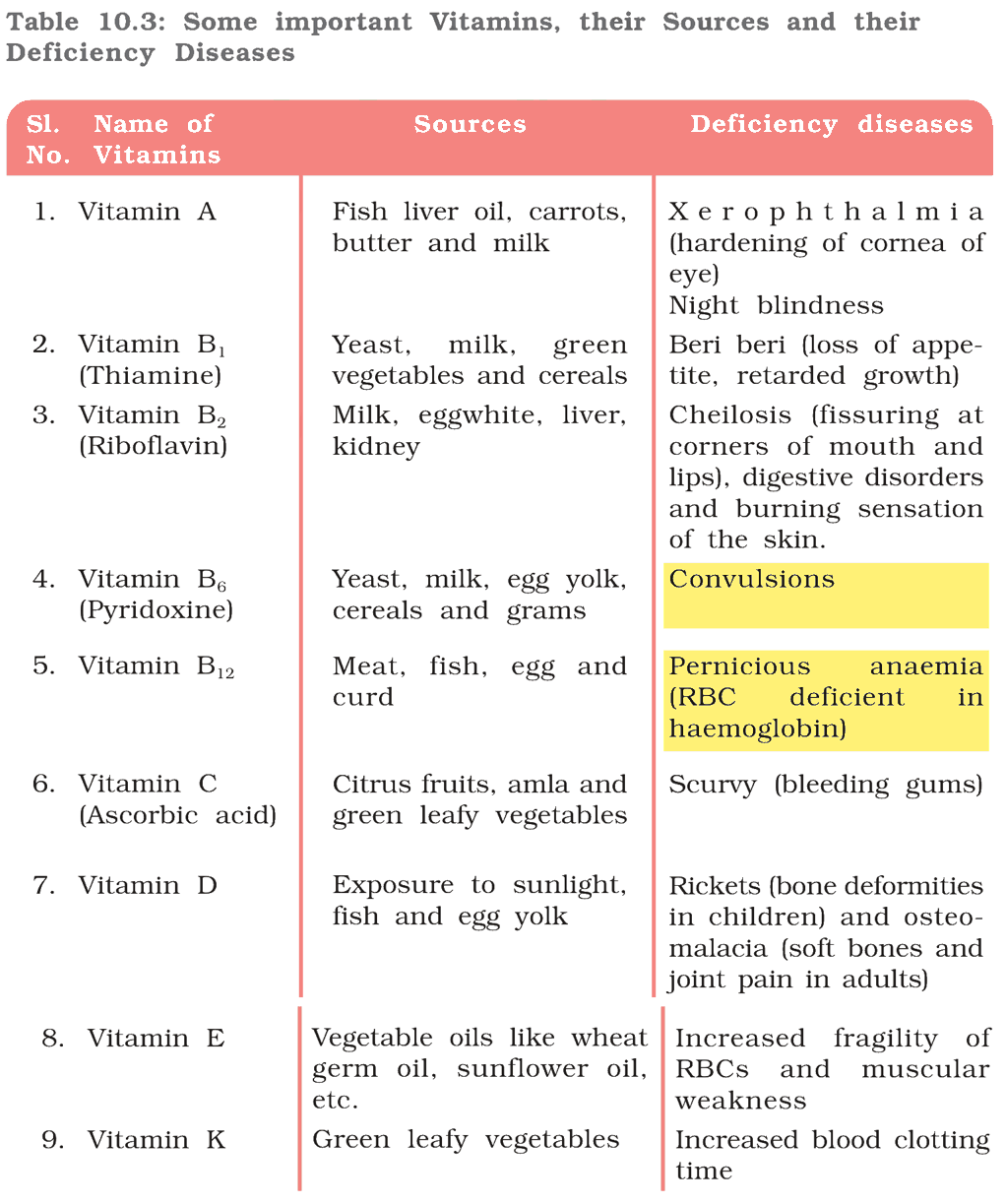
Statement II: Deficiency of vitamin B12 causes convulsions. — False. Vitamin B12 deficiency causes pernicious anaemia (RBC deficient in haemoglobin).
Convulsions are caused by a deficiency of vitamin B6 (pyridoxine).
NCERT (2026-27 edition):
10.4 Vitamins – “…Different vitamins belong to various chemical classes and it is difficult to define them on the basis of structure.”
10.4.1 Classification of Vitamins – “…Some important vitamins, their sources and diseases caused by their deficiency are listed in Table 10.3.”
Table 10.3: Some important Vitamins, their Sources and their Deficiency Diseases