
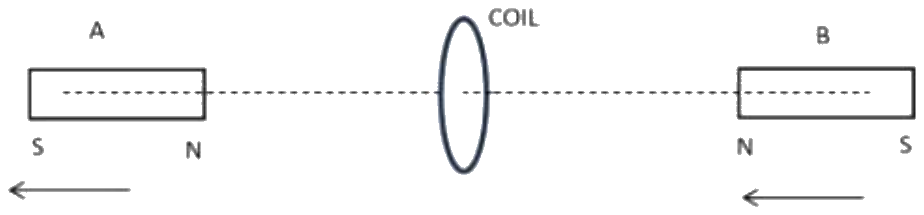
In the figure given below, two identical magnets A and B, respectively are kept equidistant from a coil of radius \( \sqrt{7} \) cm. Magnet A is moved away from the coil with a speed of \( 4 \) m/s and magnet B is moved towards the coil with same speed of \( 4 \) m/s. Induced emf in the coil will be
Answer & explanation
Correct answer: option 4
The correct answer is Option (4) → zero
Note: The given answer is as per the official NTA Answer Key. However, none of the given options appears to be correct. In the figure the north poles of both magnets face the coil, so the flux changes produced by the two moving magnets add instead of cancelling. The correct answer is a non-zero emf, whose value cannot be calculated because the strength of the magnets is not given, as explained below.
By Faraday’s law, an emf is induced only when the net flux through the coil changes; the two contributions add with their directions.
Working as per the NTA key
A moves away and B moves towards the coil at the same 4 m/s, so the flux due to A falls as fast as the flux due to B rises. If their fields at the coil point the same way, these changes cancel:
\( \frac{d\Phi_{A}}{dt} + \frac{d\Phi_{B}}{dt} = 0 \Rightarrow \varepsilon = 0 \)
Working as per the standard method
Take A → B as positive; field lines leave a north pole. The field of A at the coil is along \( + \) and falls as A moves away; the field of B is along \( - \) and grows as B approaches. Both rates are negative, so they add:
\( \frac{d\Phi}{dt} = \frac{d\Phi_{A}}{dt} + \frac{d\Phi_{B}}{dt} = 2\frac{d\Phi_{A}}{dt} \ne 0 \)
It seems that NTA has assumed that the south pole of B (not its north pole) faces the coil.