Paramagnetic substances are attracted by an external magnetic field, that is, they move from a weaker to a stronger part of the field. Paramagnetic substances contain unpaired electrons. Diamagnetic substances are repelled by an external magnetic field, that is, they tend to move away from the stronger part to the weaker part of the field. In diamagnetic substances, all the electrons are paired.
The magnetic moment of a substance arises from the spin angular momentum and the orbital angular momentum of its electrons. In many compounds of the 3d series metals, the orbital contribution is neglected, because the orbital motion of these electrons is quenched by the surrounding species in the compound or solution. The magnetic moment is then calculated by the spin-only formula, in Bohr magnetons (BM):
\[\mu_s = \sqrt{n(n + 2)}\ \text{BM}\]
where n is the number of unpaired electrons.
The number of unpaired electrons in \([Co(H_2O)_6]^{2+}\) is
Answer & explanation
Correct answer: option 3
The correct answer is Option (3) → 3
Oxidation state of Co: in \( \ce{[Co(H2O)6]^2+} \) water is neutral, so x + 6(0) = +2 and x = +2.
Configuration: Co (Z = 27) is [Ar]3d74s2; losing the two 4s electrons gives \( \ce{Co^2+} \): 3d7.
Type of ligand: towards \( \ce{Co^2+} \), water acts as a weak field ligand (Δo < P), so the complex is high spin.
Filling the d orbitals: t2g5eg2.
Paired orbitals: two t2g orbitals hold pairs.
Unpaired electrons: one t2g and both eg orbitals hold single electrons, so there are 3 unpaired electrons.
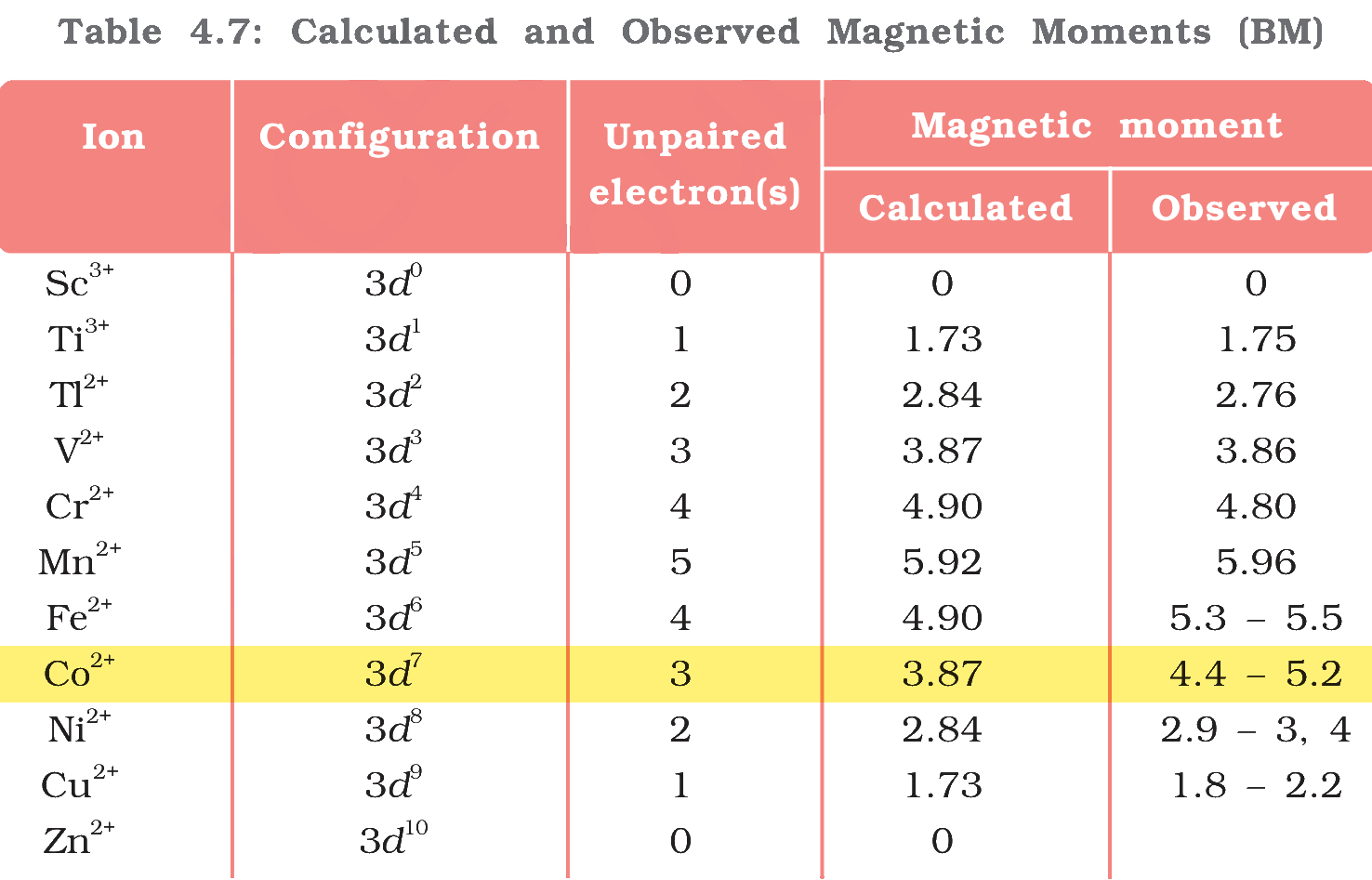
Check: Table 4.7 lists 3 unpaired electrons for Co2+; its data are mainly for hydrated ions.
NCERT (2026-27 edition):
5.5.4 Crystal Field Theory – “(i) If Δo < P, the fourth electron enters one of the eg orbitals giving the configuration t2g3eg1. Ligands for which Δo < P are known as weak field ligands and form high spin complexes.”
4.3.9 Magnetic Properties – “… The magnetic moments calculated from the ‘spin-only’ formula and those derived experimentally for some ions of the first row transition elements are given in Table 4.7. The experimental data are mainly for hydrated ions in solution or in the solid state.”