Eu2+ (Eu = 63) is stable because
Answer & explanation
Correct answer: option 2
The correct answer is Option (2) → It has half-filled electronic configuration of f-orbitals
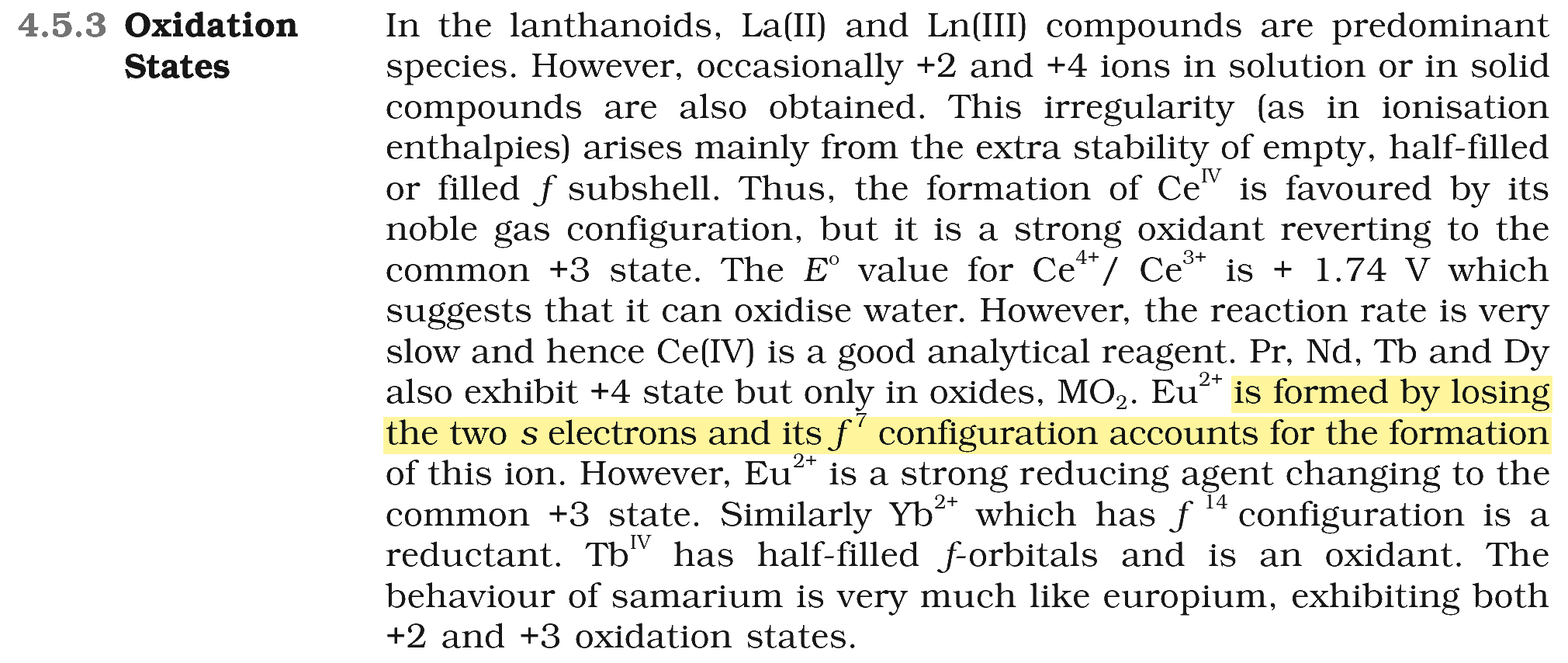
Subshells that are half-filled or completely filled have extra stability, because of their symmetrical electron distribution and larger exchange energy. In the lanthanoids, the common oxidation state is +3, but an ion with an empty (4f0), half-filled (4f7) or completely filled (4f14) 4f subshell can also be stable in a +2 or +4 state.
For europium:
\( \displaystyle \mathrm{Eu}\ (Z=63):\ [\mathrm{Xe}]\,4f^{7}\,6s^{2} \)
\( \displaystyle \mathrm{Eu^{2+}}:\ [\mathrm{Xe}]\,4f^{7}\quad(\text{the two 6s electrons are lost}) \)
\( \ce{Eu^{2+}} \) has seven electrons in the seven 4f orbitals, one in each: a half-filled f subshell. That is why Eu shows a stable +2 state.
Why the other options are incorrect
Option (1) It has half-filled electronic configuration of d-orbitals — Incorrect. \( \ce{Eu^{2+}} \) has no 5d electrons (5d0); its stability comes from the 4f subshell.
Option (3) It has fully-filled electronic configuration of f-orbitals — Incorrect. A full f subshell is 4f14, as in \( \ce{Yb^{2+}} \): Yb (Z = 70) is [Xe]4f146s2, and losing the two 6s electrons leaves 4f14. \( \ce{Eu^{2+}} \) has only 4f7.
Option (4) It has noble gas configuration — Incorrect. A noble gas configuration ([Xe], 4f0) is found in \( \ce{Ce^{4+}} \): Ce (Z = 58) is [Xe]4f15d16s2, and losing all four outer electrons leaves [Xe]. \( \ce{Eu^{2+}} \) still has seven 4f electrons.
NCERT (2026-27 edition):
Oxidation States