Which one of the following is correct formula for deriving the investment multiplier?
A. 1/(1 - MPC)
B. 1/MPS
C. 1/(1 - MPS)
D. (1 - MPC)/MPS
Choose the correct answer from the options given below:
Answer & explanation
Correct answer: option 1
The correct answer is Option (1) → A and B only
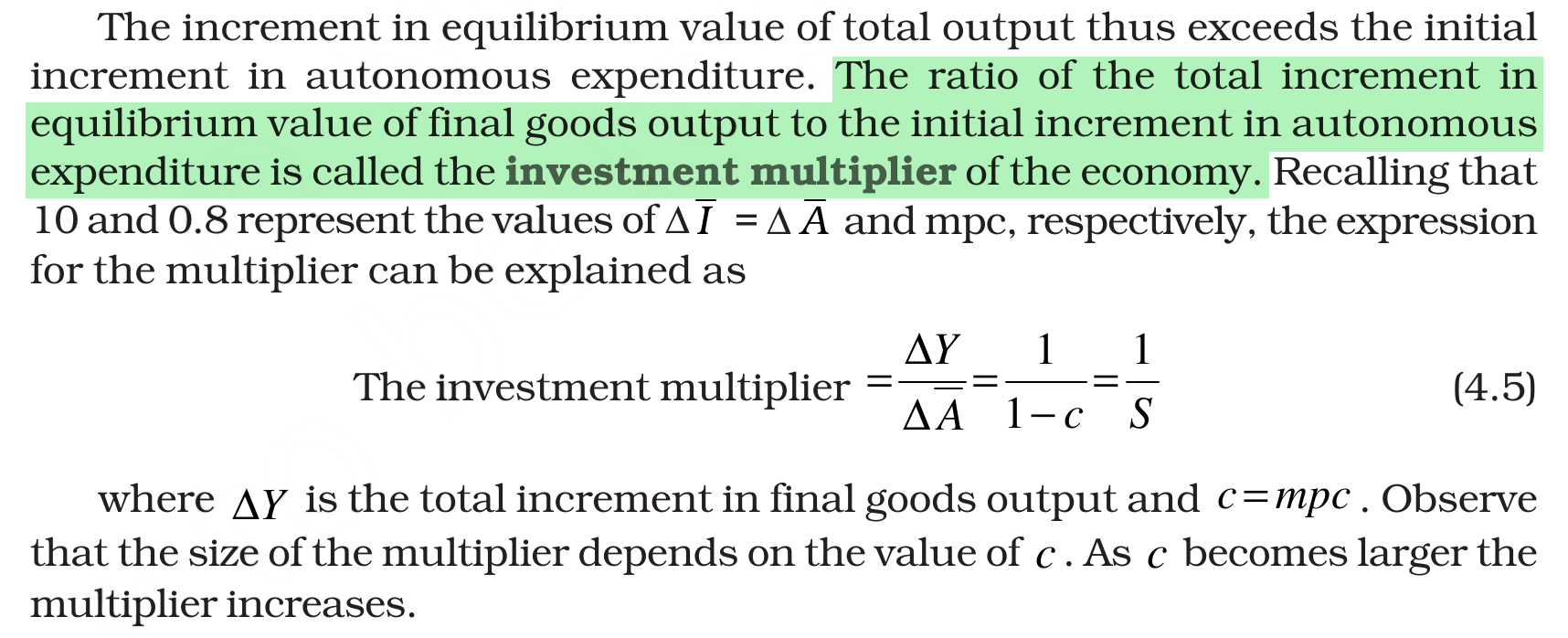
When investment rises, income rises by more, because each round of new income is partly spent again; the ratio of the total rise in income to the rise in investment is the investment multiplier. Its size depends on the share of each extra rupee that is spent, the MPC, and the share saved, the MPS. Since a rupee is either consumed or saved,
MPC + MPS = 1, and therefore 1 − MPC = MPS
The multiplier is written as 1/(1 − c), with c the MPC, and this is the same as 1/s, with s the MPS. Statements A and B are these two forms:
(A) 1/(1 - MPC). True. The multiplier in its usual form: the reciprocal of the fraction of income that leaks out of the spending stream.
(B) 1/MPS. True. Since 1 − MPC equals MPS, this is the same expression written the other way.
(C) 1/(1 - MPS). False. Here 1 − MPS equals MPC, giving 1/MPC, the reciprocal of the wrong propensity.
(D) (1 - MPC)/MPS. False. The numerator is itself MPS, so the expression reduces to MPS/MPS = 1, and a multiplier of 1 would mean nothing at all is re-spent.
NCERT: Introductory Macroeconomics — Chapter 4: Determination of Income and Employment (2025-26)
|