Which of the following amine can be synthesized by Gabriel phthalimide synthesis?
Answer & explanation
Correct answer: option 2
The correct answer is Option (2) → Ethylamine
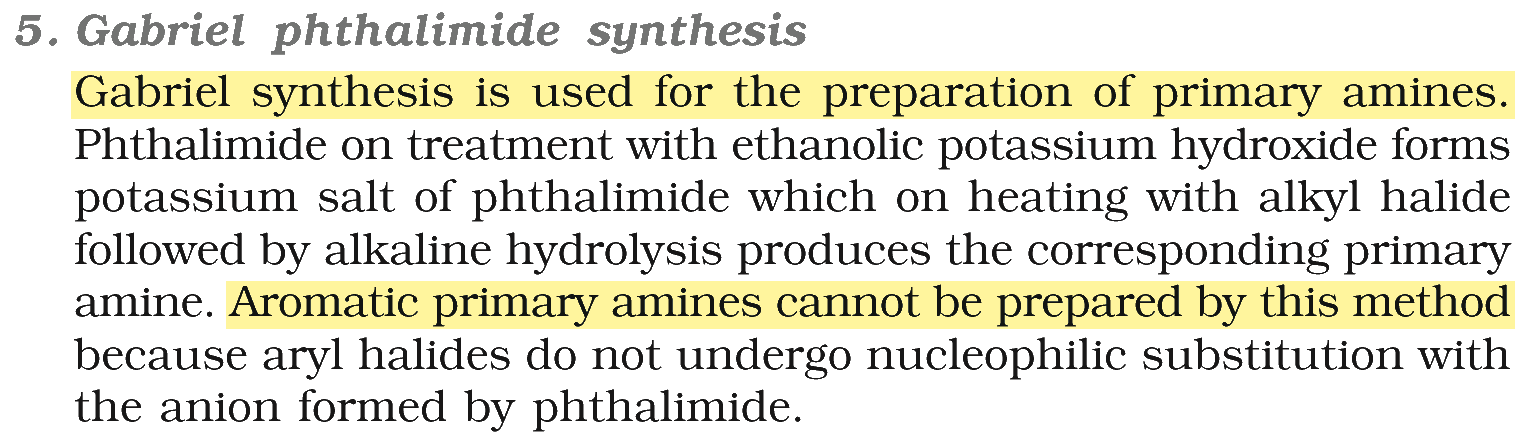
The Gabriel phthalimide synthesis is used to prepare primary amines only. Phthalimide is treated with ethanolic potassium hydroxide to form potassium phthalimide. This is heated with an alkyl halide, and the N-alkylphthalimide formed is hydrolysed with alkali to give the primary amine:
\( \displaystyle \ce{C6H4(CO)2NH + KOH} \xrightarrow{\text{ethanol}} \ce{C6H4(CO)2N^-K^+ + H2O} \)
\( \displaystyle \ce{C6H4(CO)2N^-K^+ + C2H5Br -> C6H4(CO)2N-C2H5 + KBr} \)
\( \displaystyle \ce{C6H4(CO)2N-C2H5 + 2NaOH -> C6H4(COONa)2 + C2H5-NH2} \)
Only one alkyl group can be attached to the nitrogen of phthalimide, so the amine released always has the form \( \ce{R-NH2} \). So ethylamine, a primary amine, can be prepared by this method.
Why the other options are incorrect
Option (1) N,N-diethylamine — Incorrect. Diethylamine, \( \ce{(C2H5)2NH} \), has two ethyl groups on nitrogen. It is a secondary amine.
Option (3) N-ethylaniline — Incorrect. \( \ce{C6H5NHC2H5} \) is a secondary aromatic amine. Aromatic amines cannot be made by this method at all, because aryl halides do not undergo nucleophilic substitution with the phthalimide anion.
Option (4) N-ethylethanamine — Incorrect. This is the IUPAC name of diethylamine, \( \ce{(C2H5)2NH} \), again a secondary amine.
NCERT (2026-27 edition):
Gabriel Phthalimide Synthesis