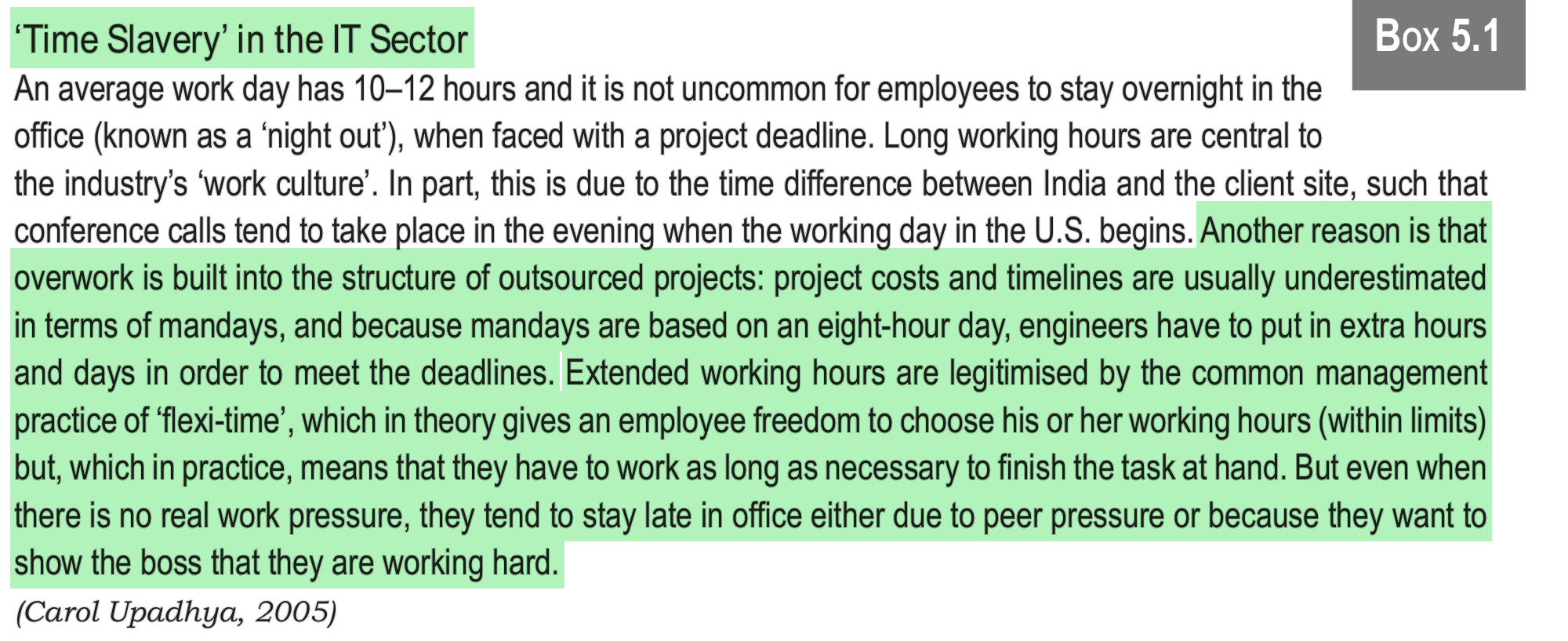
An IT company offers “Flexi-time,” but employees regularly stay late because deadlines are underestimated and peer pressure is strong. Which concept best explains their experiences?
Answer & explanation
Correct answer: option 2
The correct answer is Option (2) → Time slavery in IT sector
Option (1) Mechanisation replacing labour — Incorrect. Mechanisation means machines doing work that people once did; Marx and Mahatma Gandhi both saw it as a danger to employment. The IT employees are not being replaced – they are made to work longer.
Option (2) Time slavery in IT sector — Correct. Long working hours are central to the IT industry’s work culture: project costs and timelines are usually underestimated, so engineers put in extra hours to meet deadlines. ‘Flexi-time’ in theory lets employees choose their hours, but in practice it means working as long as the task needs, and many stay late because of peer pressure or to show the boss they are working hard.
Option (3) Occupational mobility — Incorrect. Occupational mobility is the movement of people from one occupation to another, for example from farming to factory work. The employees in the case stay in the same job; the problem is the length of their working day.
Option (4) Gendered division of labour — Incorrect. A gendered division of labour assigns different kinds of work to women and men, such as housework to women and paid work outside to men. The case speaks of all employees alike, with no division by gender.
Note: The concepts in Option (3) and Option (4), ‘occupational mobility’ and ‘gendered division of labour’, are not in NCERT (2025-26); explained here for the benefit of the students.
NCERT: Social Change and Development in India — Chapter 5: Change and Development in Industrial Society (2025-26)
|