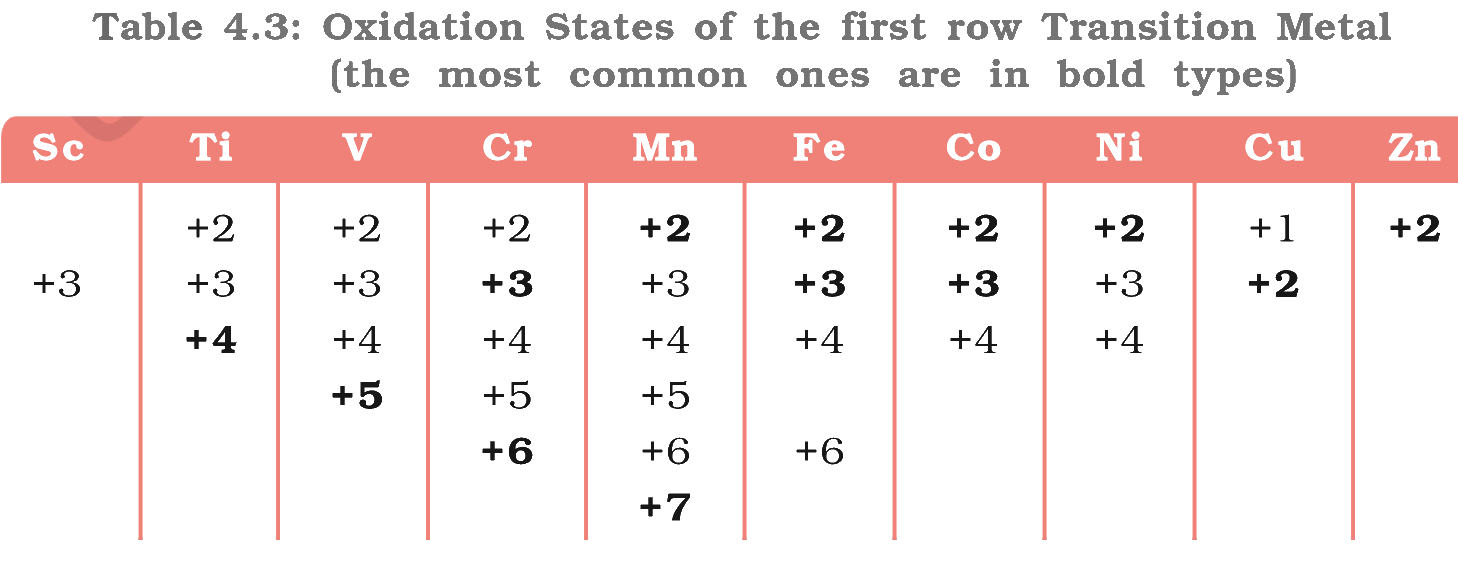
Which of the following transition element shows a maximum oxidation state of +6?
Answer & explanation
Correct answer: option 2
The correct answer is Option (2) → Chromium
Transition elements show variable oxidation states because both the 4s and the 3d electrons can take part in bonding. Up to manganese, the highest oxidation state equals the total number of 4s and 3d electrons; after manganese the extra d electrons are paired and the highest state falls.
Cr (Z = 24) is [Ar]3d54s1: six 4s and 3d electrons, so its highest state is +6, as in \( \ce{CrO3} \) and \( \ce{Cr2O7^{2-}} \).
So chromium is the element whose maximum oxidation state is +6.
Why the other options are incorrect
Option (1) Vanadium — Incorrect. It has five 4s and 3d electrons, so its maximum oxidation state is +5.
Option (3) Cobalt — Incorrect. After manganese the extra d electrons are paired, so its maximum state falls to +4; its common states are +2 and +3.
Option (4) Nickel — Incorrect. Its maximum oxidation state is +4; its common state is +2.
NCERT (2026-27 edition):
Oxidation States