Consider the following statements about critical point control:
(A) Critical point control holds that it is neither economical nor easy to keep a check on each and every activity in an organisation.
(B) Under critical point control, the key result areas which are critical to the success of an organisation are set as the critical points.
(C) Critical point control and management by exception should be used by a manager while setting performance standards.
(D) Critical point control is based on the belief that an attempt to control everything results in controlling nothing.
Which of the statements given above are correct?
Choose the correct answer from the options given below:
Answer & explanation
Correct answer: option 3
The correct answer is Option (3) → (A) and (B) only
(A) Critical point control holds that it is neither economical nor easy to keep a check on each and every activity in an organisation. — Correct. Checking every activity is neither economical nor easy. So control picks a few areas.
(B) Under critical point control, the key result areas which are critical to the success of an organisation are set as the critical points. — Correct. The key result areas (KRAs) are set as the critical points. If anything goes wrong there, the whole firm suffers.
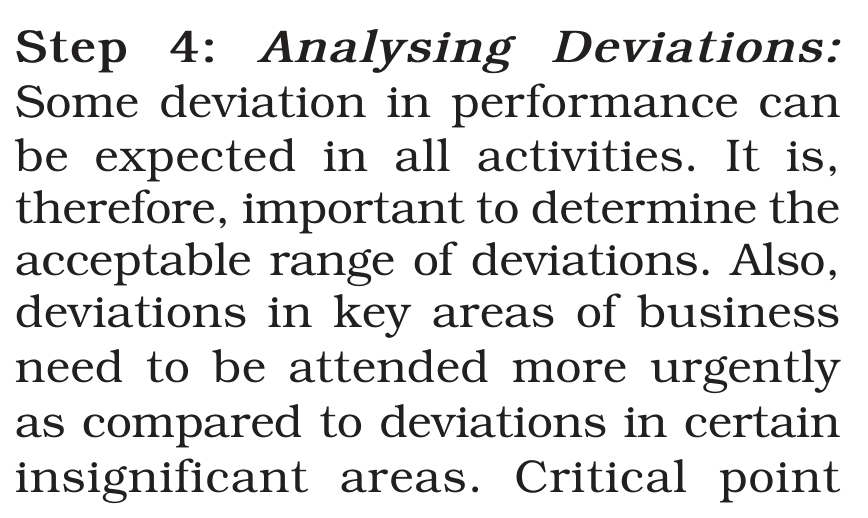
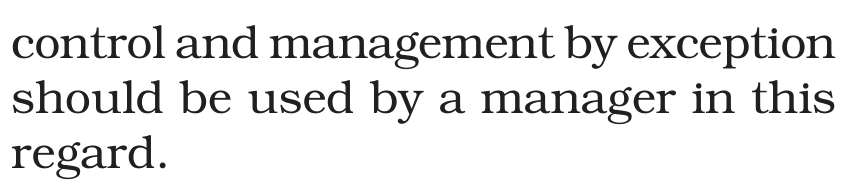
(C) Critical point control and management by exception should be used by a manager while setting performance standards. — Incorrect. These two principles are used while analysing deviations, to decide which deviations need attention.
(D) Critical point control is based on the belief that an attempt to control everything results in controlling nothing. — Incorrect. This belief is the basis of management by exception.
NCERT (2026-27 Edition): “1. Critical Point Control: It is neither economical nor easy to keep a check on each and every activity in an organisation. Control should, therefore, focus on key result areas (KRAs) which are critical to the success of an organisation. These KRAs are set as the critical points. If anything goes wrong at the critical points, the entire organisation suffers. For instance, in a manufacturing organisation, an increase of 5 per cent in the labour cost may be more troublesome than a 15 per cent increase in postal charges.” “2. Management by Exception: Management by exception, which is often referred to as control by exception, is an important principle of management control based on the belief that an attempt to control everything results in controlling nothing. Thus, only significant deviations which go beyond the permissible limit should be brought to the notice of management. Thus, if the plans lay down 2 per cent increase in labour cost as an acceptable range of deviation in a manufacturing organisation, only increase in labour cost beyond 2 per cent should be brought to the notice of the management. However, in case of major deviation from the standard (say, 5 per cent), the matter has to receive immediate action of management on a priority basis. …”
|