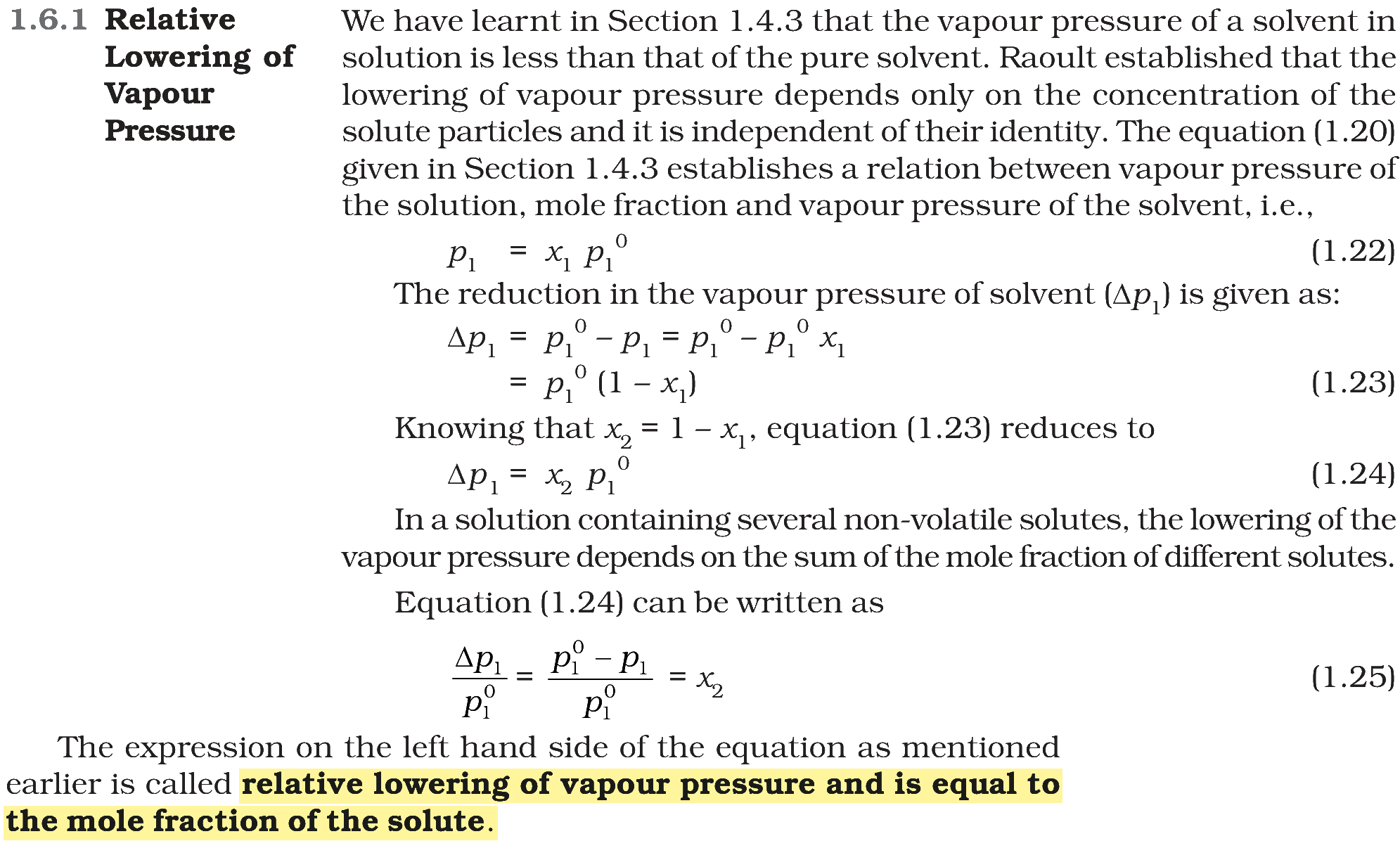
The relative lowering of vapor pressure is equal to the
Answer & explanation
Correct answer: option 1
The correct answer is Option (1) → mole fraction of solute
A non-volatile solute lowers the vapour pressure of the solvent. By Raoult’s law, \( p_1 = x_1\,p_1^{0} \), and since \( x_1 + x_2 = 1 \) the lowering divided by the vapour pressure of the pure solvent comes out equal to \( x_2 \):
\( \displaystyle \frac{p_1^{0} - p_1}{p_1^{0}} = x_2 \)
So the relative lowering of vapour pressure equals the mole fraction of the solute; it depends only on the number of solute particles, which makes it a colligative property.
Why the other options are incorrect
Option (2) boiling point of solvent — Incorrect. The boiling point is a temperature, not a ratio; its elevation is a separate colligative property.
Option (3) mole fraction of solvent — Incorrect. The mole fraction of the solvent equals the ratio \( p_1 / p_1^{0} \), not the relative lowering; the two add up to 1.
Option (4) Vapor pressure of solute — Incorrect. The solute is non-volatile, so its vapour pressure is negligible; it lowers the vapour pressure only by diluting the solvent.
NCERT (2026-27 edition):
Relative Lowering of Vapour Pressure