Read the following passage carefully and answer the questions.
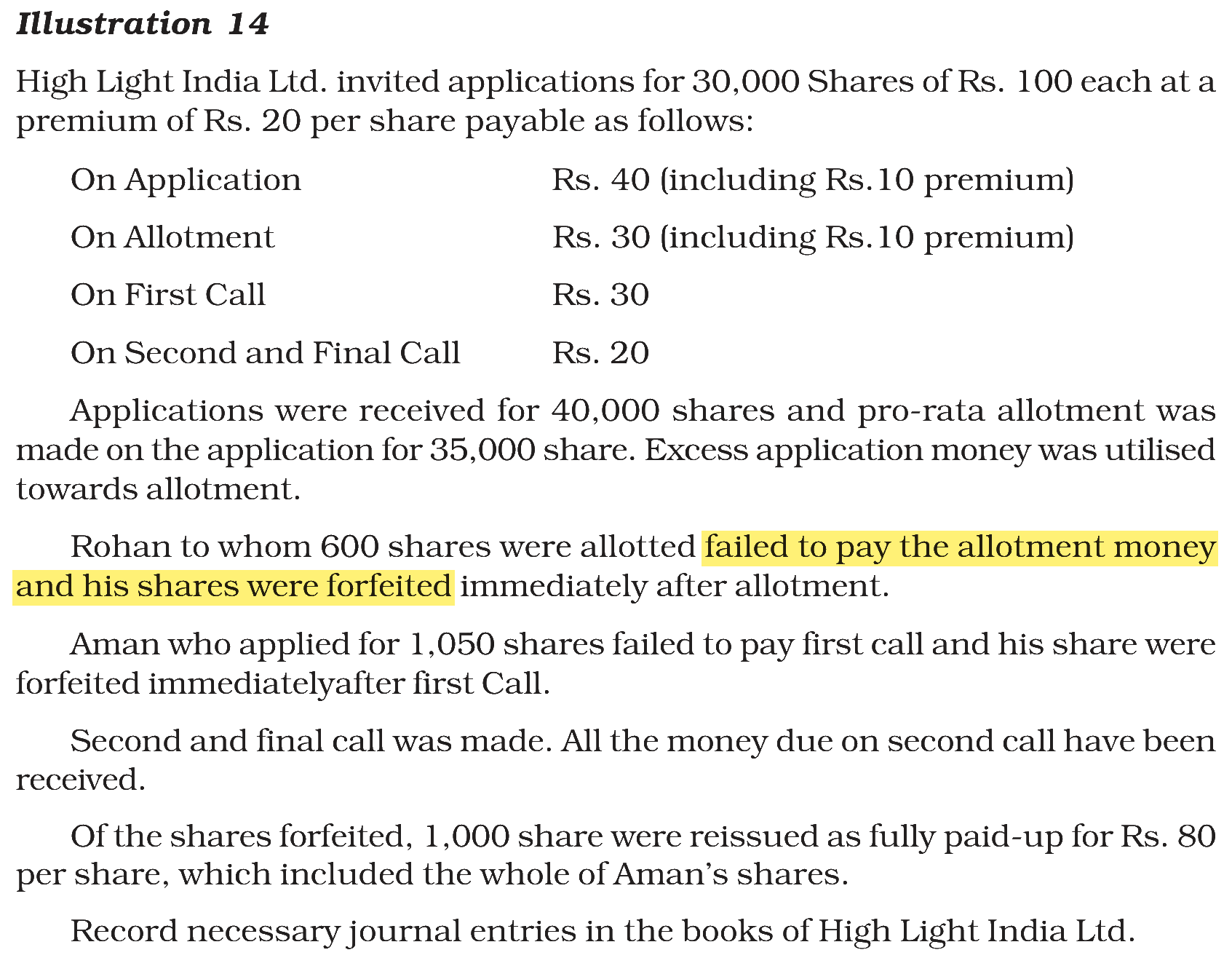
X Ltd. issued 30,000 shares to the public having Face value ₹100 at 10% premium. Money is receivable as follows:
Application = ₹40 (including premium)
Allotment = ₹45
First and Final call = Remaining amount
The public applied for 50,000 shares. The company rejected application for 10,000 shares and made a pro rata allotment to the rest of the applicants. A shareholder applying for 400 shares, didn't pay the allotment and call money and his allotted shares were forfeited by the company. Later, the forfeited shares were reissued at ₹80 each as fully paid.
Amount to be credited to Calls-in Arrears account at the time of forfeiture is:
Answer & explanation
Correct answer: option 3
The correct answer is Option (3) → ₹17,000
Calls-in-Arrears at forfeiture is the money that was called on the forfeited shares but not paid. First find how many shares the defaulter got, then what he still owed after his excess application money was adjusted.
Shares allotted to him:
Pro-rata ratio = 30,000 shares allotted : 40,000 shares applied = 3 : 4
Shares allotted = 400 × 3/4 = 300
Allotment money unpaid:
Application money paid = 400 × ₹40 = ₹16,000
Needed on application for 300 shares = 300 × ₹40 = ₹12,000
Excess adjusted to allotment = ₹16,000 − ₹12,000 = ₹4,000
Allotment due = 300 × ₹45 = ₹13,500
Allotment unpaid = ₹13,500 − ₹4,000 = ₹9,500
Call money unpaid:
First and final call per share = ₹110 − ₹40 − ₹45 = ₹25
Call unpaid = 300 × ₹25 = ₹7,500
Calls-in-Arrears credited = ₹9,500 + ₹7,500 = ₹17,000
NCERT (2026-27 edition):
|