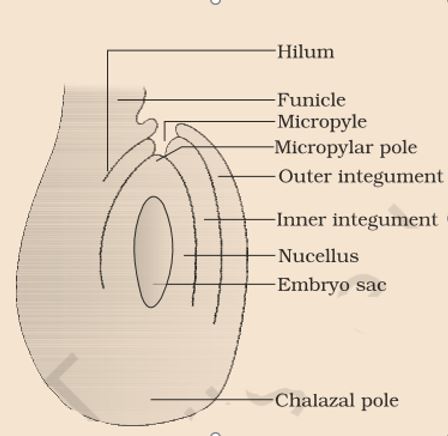
Which one of the following is not associated with megasporangium?
Answer & explanation
Correct answer: option 3
The correct answer is Option (3) → Generative cell
Pollen grains represent the male gametophyte in seed plants, and they play a crucial role in the sexual reproduction of these plants. When the pollen grain is mature it contains two cells, the vegetative cell and generative cell . The vegetative cell is bigger, has abundant food reserve and a large irregularly shaped nucleus. The generative cell is small and floats in the cytoplasm of the vegetative cell. It is spindle shaped with dense cytoplasm and a nucleus.
The Megasporangium (Ovule):
The structure of a typical angiosperm ovule consists of several parts. The ovule is a small structure attached to the placenta by a stalk called the funicle.
The body of the ovule fuses with the funicle at a region known as the hilum, which represents the junction between the ovule and the funicle.
Surrounding the ovule are one or two protective envelopes called integuments.
The integuments enclose the nucellus, except at the tip where a small opening called the micropyle is present.
Opposite the micropylar end is the chalaza, which is the basal part of the ovule.
Inside the integuments, there is a mass of cells known as the nucellus. The cells of the nucellus contain abundant reserve food materials.
Within the nucellus, the embryo sac or female gametophyte is located. Typically, an ovule contains a single embryo sac formed from a megaspore.