
In the potentiometer circuit the balance point is at X. The balance point will be shifted right towards B when :
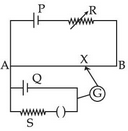
(A) Resistance R is increased keeping all other parameters constant
(B) Resistance S is increased keeping all other parameters constant
(C) Cell P is replaced by another cell whose emf is lower than Q
(D) The polarity of Q is reversed
Choose the correct answer from the options given below:
Answer & explanation
Correct answer: option 3
The correct answer is Option (3) → (A), (B) only
The driver cell P sends a steady current through the wire AB, giving a potential gradient \( k \). At the balance point the drop along AX equals the voltage \( V \) applied by the lower circuit.
\( \displaystyle V = k\,l_{AX} \;\Rightarrow\; l_{AX} = \frac{V}{k} \)
X moves towards B when \( k \) falls or \( V \) rises. S is connected across the cell Q, so the voltage balanced is the terminal potential difference of Q (internal resistance \( r \)):
\( \displaystyle V = \frac{E_Q\,S}{S + r} \)
(A) Resistance R is increased keeping all other parameters constant — Correct. A larger R lowers the current in AB, so the potential gradient falls; X moves towards B.
(B) Resistance S is increased keeping all other parameters constant — Correct. A larger S draws less current from Q, so the terminal voltage of Q rises; X moves towards B.
(C) Cell P is replaced by another cell whose emf is lower than Q — Incorrect. The drop along the whole wire is then less than the voltage of Q, so no balance point exists.
(D) The polarity of Q is reversed — Incorrect. Reversed, Q aids the drop along AX instead of opposing it, so there is no balance point.