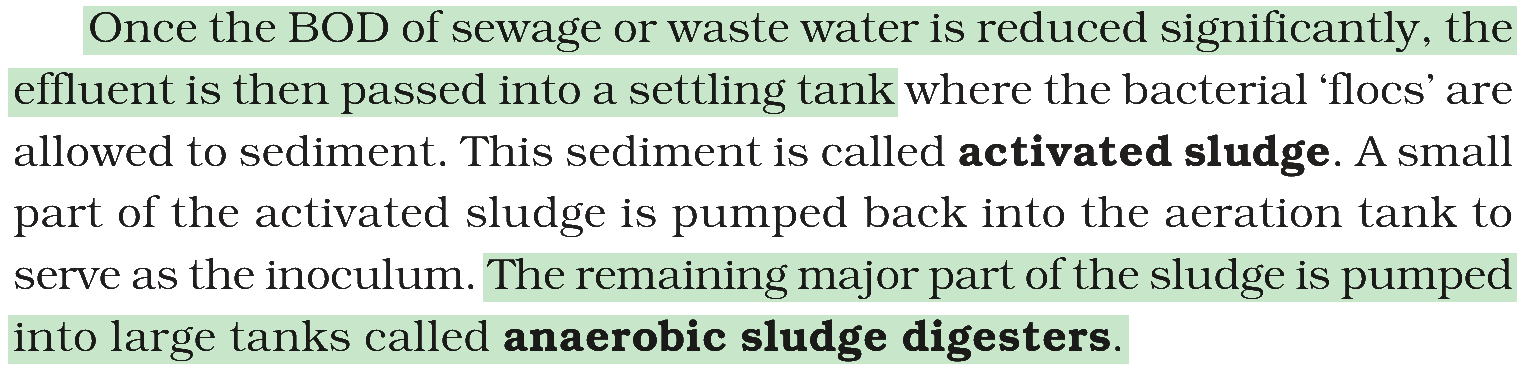
Arrange the following steps of sewage treatment in correct sequence.
(A) Effluent from the primary settling tank is taken for secondary treatment
(B) Physical removal of particles through filtration and sedimentation
(C) Remaining part of sludge is pumped into anaerobic sludge digesters
(D) Once BOD of waste water is reduced, then the effluent is passed in settling tank
Choose the correct answer from the options given below:
Answer & explanation
Correct answer: option 3
The correct answer is Option (3) → (B), (A), (D), (C)
(B) Physical removal of particles through filtration and sedimentation — first. This is the primary treatment. Floating debris is removed by filtering, and grit is removed by letting it settle. The solids form the primary sludge, and the liquid above it is the effluent.
(A) Effluent from the primary settling tank is taken for secondary treatment — second. In the secondary (biological) treatment, the effluent is stirred with air in aeration tanks. Useful aerobic microbes grow into flocs and use up the organic matter.
(D) Once BOD of waste water is reduced, then the effluent is passed in settling tank — third. BOD (biochemical oxygen demand) shows how much organic matter is left. When it falls enough, the effluent goes to a settling tank, where the flocs settle as activated sludge.
(C) Remaining part of sludge is pumped into anaerobic sludge digesters — last. A small part of the activated sludge goes back to the aeration tank. The rest is digested by anaerobic bacteria, which give out biogas.
Note: A similar question was also asked in CUET (UG) 2026 on 31-05-2026 (Slot 2), on 24-05-2026 (Slot 1), on 20-05-2026 (Slot 2), on 18-05-2026 (Slot 1) and on 15-05-2026 (Slot 1).
NCERT Extract:
Microbes in Sewage Treatment – …