
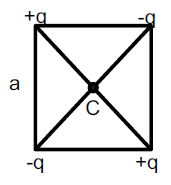
Charges +q, −q, +q and −q are placed at the corners of a square of side a, as shown in the figure (equal charges at opposite corners). What is the electric potential at the centre C of the square?
Answer & explanation
Correct answer: option 1
The correct answer is Option (1) → Zero
Electric potential is a scalar. By the superposition principle, the potential at a point due to several charges is the algebraic sum of the potentials \( kq/r \) due to each charge. Here \( k=1/4\pi\varepsilon_0 \). Positive and negative charges give potentials of opposite sign.
From the figure, \( +q \) sits at two opposite corners and \( -q \) at the other two. The centre C is half a diagonal away from every corner:
\( \begin{aligned} r &= \frac{\sqrt{2}\,a}{2} \\ &= \frac{a}{\sqrt{2}} \end{aligned} \)
The potential at C is then:
\( \begin{aligned} V_C &= \frac{kq}{r}+\frac{k(-q)}{r}+\frac{kq}{r}+\frac{k(-q)}{r} \\ &= \frac{k}{r}\,(q-q+q-q) \\ &= 0 \end{aligned} \)
NCERT (2026-27):
Potential Due to a System of Charges – “… By the superposition principle, the potential V at P due to the total charge configuration is the algebraic sum of the potentials due to the individual charges
\( V=V_1+V_2+\ldots+V_n \qquad (2.17) \)”