Select the Incorrect statement from the following for [Ti(H2O)6]Cl3.
Answer & explanation
Correct answer: option 3
The correct answer is Option (3) → On strong heating colour of [Ti(H2O)6]Cl3 changes to yellow.
The colour of most transition metal complexes comes from a d–d transition. The ligands split the d orbitals; in an octahedral field they split into a lower t2g set and a higher eg set, separated by Δo. An electron absorbs visible light of energy Δo and moves from t2g to eg; the complex shows the complementary colour.
For \( \ce{[Ti(H2O)6]^{3+}} \), the oxidation state of Ti (\( \ce{H2O} \) is neutral):
\( \displaystyle x+6(0)=+3 \)
\( \displaystyle x=+3 \)
Ti (Z = 22) is [Ar]3d24s2; losing the two 4s electrons and one 3d electron gives Ti3+: 3d1, i.e. t2g1eg0. The complex absorbs blue-green light (about 498 nm) and looks violet.
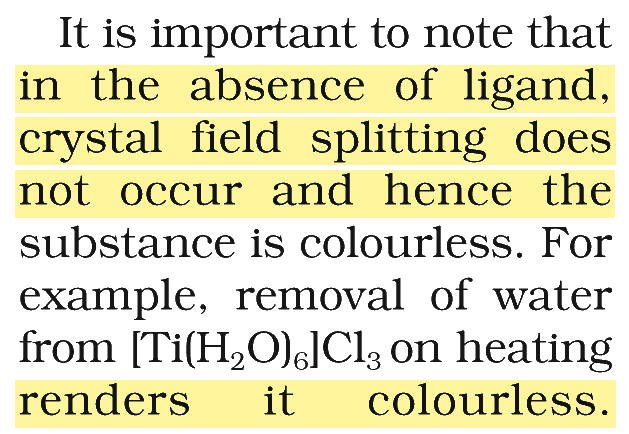
On strong heating the water ligands are lost, so the compound becomes colourless, not yellow.
Option (1) It is violet in colour. — A correct statement for [Ti(H2O)6]Cl3. It absorbs in the blue-green region, so it appears violet.
Option (2) Colour of this complex is due to d-d transition of the electron. — A correct statement for [Ti(H2O)6]Cl3. The single 3d electron is promoted from t2g to eg.
Option (3) On strong heating colour of [Ti(H2O)6]Cl3 changes to yellow. — The incorrect statement. Without the water ligands there is no crystal field splitting, so it becomes colourless.
Option (4) Metal ion ground state electronic configuration is t2g1eg0. — A correct statement for [Ti(H2O)6]Cl3. \( \ce{Ti^{3+}} \) (3d1) places its one electron in the lower-energy t2g set.
NCERT (2026-27 edition):
Colour in Coordination Compounds – …