If \(\phi(n)\) represents Euler’s totient function, then \(\phi(432)\) is:
Answer & explanation
Correct answer: option 1
The correct answer is Option (1) → 144
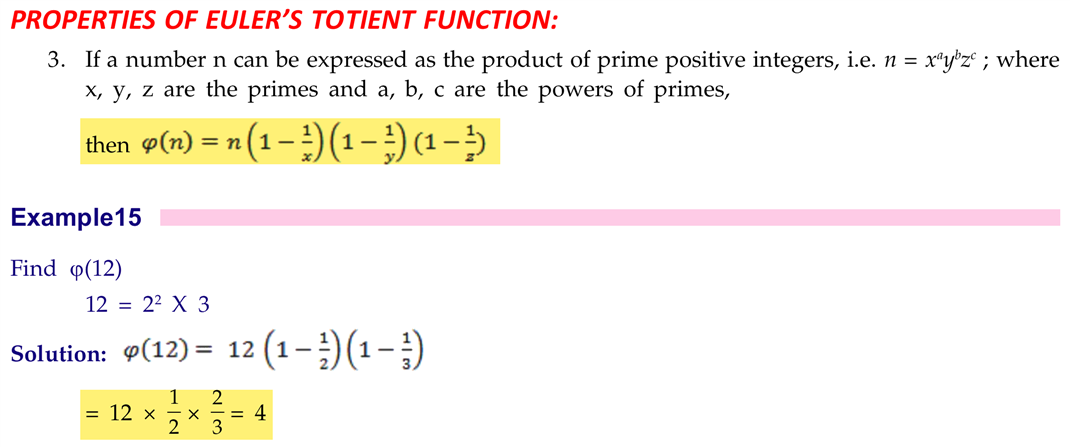
Euler’s totient function \(\phi(n)\) counts the numbers from 1 to n that are coprime to n. If the distinct prime factors of n are \(p_1, p_2, \ldots\), then
\(\displaystyle \phi(n) = n\left(1-\frac{1}{p_1}\right)\left(1-\frac{1}{p_2}\right)\cdots\)
Prime factorisation:
\(432 = 16\times 27 = 2^4\times 3^3\)
So the distinct primes are 2 and 3:
\(\displaystyle \phi(432) = 432\left(1-\frac{1}{2}\right)\left(1-\frac{1}{3}\right)\)
\(\displaystyle = 432\times\frac{1}{2}\times\frac{2}{3} = 144\)
CBSE Applied Mathematics (Class XII):
Euler's Totient Function