
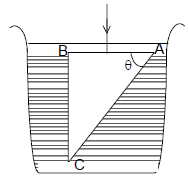
A glass prism of refractive index 1.5 is immersed in water (refractive index 4/3). A beam of light incident normally on the face AB is totally reflected at the face AC to reach the face BC if
Answer & explanation
Correct answer: option 1
The correct answer is Option (1) → \( \sin\theta\ge \frac{8}{9} \)
Total internal reflection at the glass–water face needs a large enough angle of incidence inside the glass. It must reach the critical angle \( i_c \) for this pair of media. Here \( \sin i_c=n_{21} \), the refractive index of water relative to glass.
From the figure, the beam falls normally on AB, so it goes on undeviated, perpendicular to AB.
At AC the angle of incidence is the angle between this beam and the normal to AC. It equals the angle between the faces AB and AC, so the angle of incidence at AC is \( \theta \).
The critical angle for glass and water is:
\( \begin{aligned} \sin i_c &= \frac{n_{\mathrm{water}}}{n_{\mathrm{glass}}} \\ &= \frac{4/3}{1.5} \\ &= \frac{8}{9} \end{aligned} \)
The beam is totally reflected at AC when:
\( \sin\theta\ge\sin i_c \)
\( \Rightarrow\; \sin\theta\ge 8/9 \)
NCERT (2026-27):
Total Internal Reflection – “The angle of incidence corresponding to an angle of refraction 90°, … is called the critical angle (ic) for the given pair of media. We see from Snell’s law … that if the relative refractive index of the refracting medium is less than one then, since the maximum value of sin r is unity, there is an upper limit to the value of sin i for which the law can be satisfied, that is, i = ic such that
\( \sin i_c=n_{21} \)\( \qquad (9.12) \)
For values of i larger than ic, Snell’s law of refraction cannot be satisfied, and hence no refraction is possible.”