CUETMOCK
  • Pricing
  • Mentors
Log inStart freeStart free mocks→

First test, then trust

Try a free CUET mock test.

Join 5,00,000+ students who rehearsed exam day on the exact NTA screen before sitting CUET. On the web and on Android.

Start free mocks →Get the Android app
CUETMOCK

India's #1 CUET Mock Test Platform. Original NCERT-based questions on the exact NTA exam screen — trusted by 5,00,000+ students since CUET 2022.

Get it onGoogle PlayScan to download the CUETMOCK app

Mock tests

  • CUET mock test series
  • Browse all papers
  • Commerce mocks
  • Humanities (Arts) mocks
  • Science mocks
  • Languages & GAT mocks
  • Free practice questions
  • Pricing

Resources

  • CUET exam guide
  • CUET syllabus
  • Universities accepting CUET
  • Expert blogs
  • News & notifications
  • Webinars & counselling
  • CUET score calculator
  • How we estimate your rank
  • FAQs

Company

  • About us
  • Our leadership & team
  • Our toppers
  • Mentors
  • For schools
  • Contact us
  • Terms
  • Privacy
  • Refund policy

Talk to us

+91 7696 6630 56info@cuetmock.comWhatsApp us

Our other platforms

  • JEE Mock — For IIT-JEE aspirants
  • NEET Mock — For NEET aspirants

Newsletter

Exam updates, study material and offers — no spam.

© 2026 NYC Ventures Pvt. Ltd.

701-702, Royal Business Park, Zirakpur, Punjab - 140603

  • Terms of use
  • Privacy policy
  • Refund policy
  • Contact us

iCUETMOCK is an independent preparation platform, not affiliated with the National Testing Agency (NTA). Always check exam details on the official NTA website.

  • Home
  • Mock tests
  • CUET guide
  • Pricing
  • Log in
Home/Practice questions/Sociology
SociologyIndian Society: Challenges of Cultural Diversity

Arrange the following statements as they have happened chronologicall…

Arrange the following statements as they have happened chronologically in the process of nation- building in India.

(A) Bangladesh Liberation War
(B) Official Secrets Act
(C) Right to Information Act
(D) States Reorganisation Commission
(E) Constitution of India adopted

Choose the correct answer from the options given below:

Answer & explanation+

Correct answer: option 2

The correct answer is Option (2) → (B), (E), (D), (A), (C)

(B) Official Secrets Act — 1923, under colonial rule; it restricted the disclosure of government information.

(E) Constitution of India adopted — 1949, in force from 26 January 1950.

(D) States Reorganisation Commission — its report was implemented on 1 November 1956; soon after the adoption of the Constitution, the provinces of the colonial era were reorganised into linguistic States.

(A) Bangladesh Liberation War — 1971, which led to the division of Pakistan and the formation of Bangladesh.

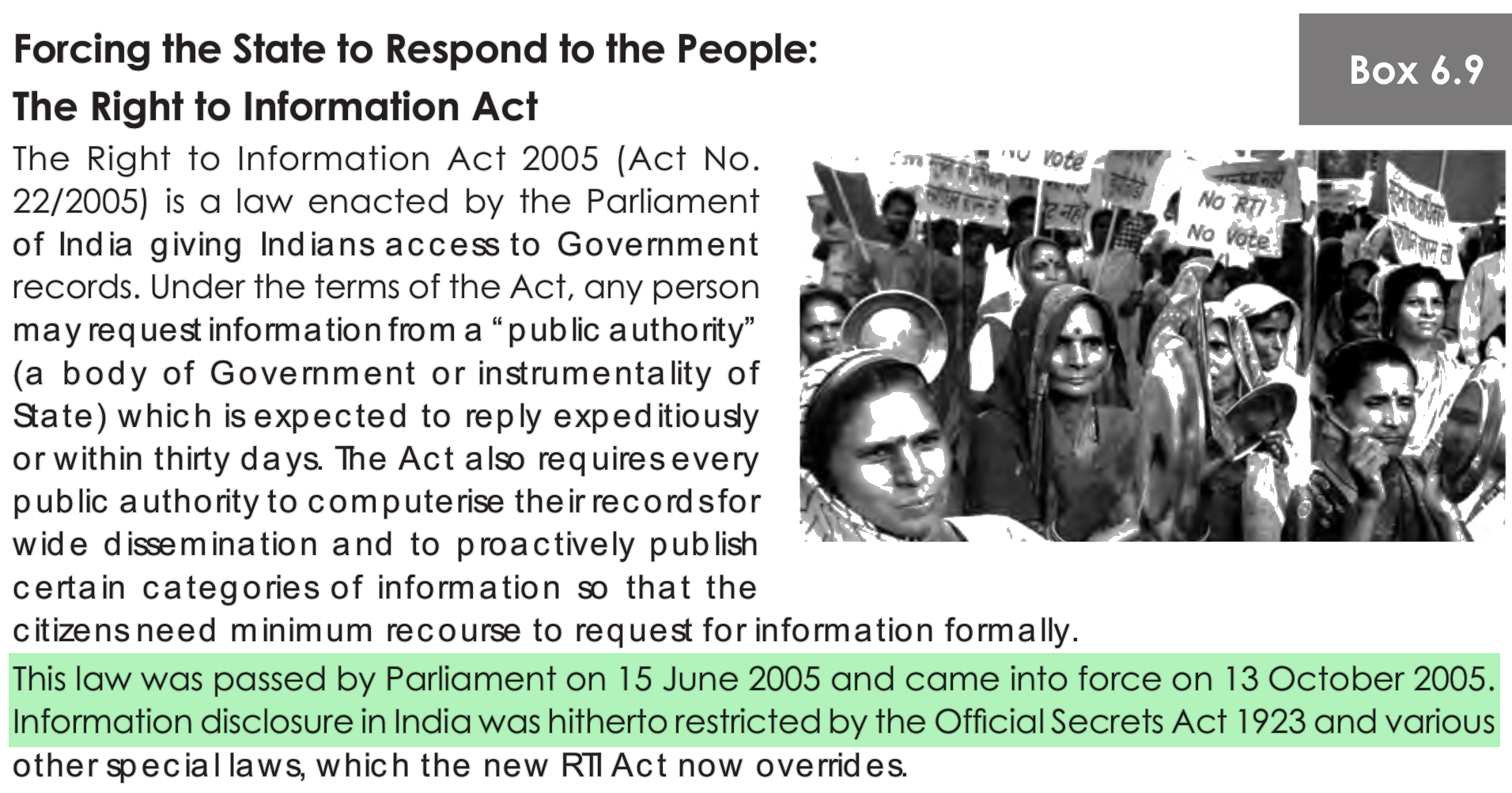
(C) Right to Information Act — passed by Parliament on 15 June 2005; it overrides the Official Secrets Act of 1923.


NCERT (2025-26): “6.2 Regionalism in the Indian Context … After Independence, initially the Indian state continued with the BritishIndian arrangement dividing India into large provinces, also called ‘presidencies’. (Madras, Bombay, and Calcutta were the three major presidencies; incidentally, all three cities after which the presidencies were named have changed their names recently). These were large multi-ethnic and multilingual provincial states constituting the major political-administrative units of a semi-federal state called the Union of India. Soon after the adoption of the Constitution, all these units of the colonial era had to be reorganised into ethno-linguistic States within the Indian union in response to strong popular agitations.…”

NCERT extract

Box 6.3, Linguistic States Helped Strengthen Indian Unity

NCERT extract

Box 6.9, Forcing the State to Respond to the People: The Right to Information Act

Advertisement

Practise more on Indian Society: Challenges of Cultural Diversity

Chapter-wise mocks on the real NTA exam screen, with solutions and your rank. Your first mocks are free.

Start free mocks →

Advertisement

Next questions

  1. Management is a complex activity that has three dimensions. Identify the dimension which is not included in it.Business Studies · Nature and significance of Management
  2. The aqueous solution of the following salts will be coloured in the case of:Chemistry · Inorganic: D and F Block Elements
  3. In which year had India's ratio of public debt to GDP gone up to a record 84.2%?General Aptitude Test · General Knowledge
  4. Four jumbled sentences are given. Select the option that gives their correct order. A. Saranda forests, in Singhbum, are a huge catchment f…English · Arrange in Meaningful Sequence
  5. The following pie chart shows the population of 7 villages. What is the different between the population of villages E and D, if the total…General Aptitude Test · Quantitative Reasoning
  6. The cause of Down’s syndrome is:Biology · Principles of Inheritance and Variation
  7. In the given question, a statement of Assertion is followed by a statement of Reason. Mark the correct answer. Assertion: When the second f…Political Science · Politics in India Since Independence: Politics of Planned Development
  8. The objective of a reflecting telescope is a:Physics · Ray Optics
  9. Select the most appropriate ANTONYM of the given word. StupendousEnglish · Antonyms
  10. A train travels at a speed of 132 km/h and halts for five junctions for a certain time. It covers a certain distance of 2970 km in one day.…General Aptitude Test · Numerical Ability