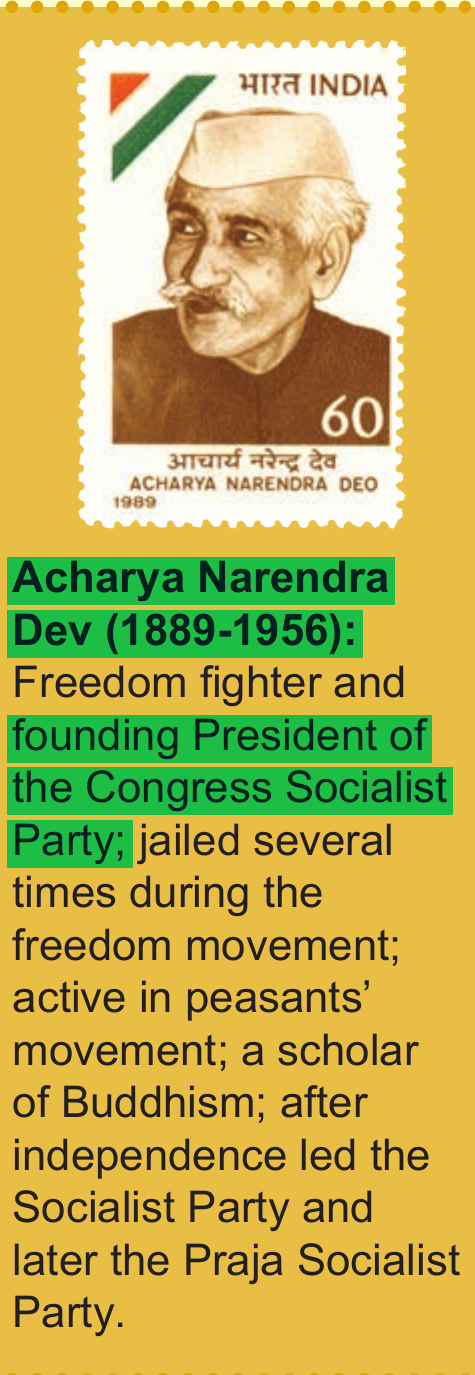
Which of the following statements are correct about Socialist Party?
(A) The Congress Socialist Party was formed in 1939.
(B) The socialists believed in the ideology of democratic socialism.
(C) The Socialist Party went through many splits and reunions leading to the formation of many socialist parties.
(D) Acharya Narendra Dev was the founding President of the Congress Socialist Party.
Choose the correct statements from the options given below:
Answer & explanation
Correct answer: option 4
The correct answer is Option (4) → (B), (C) and (D) only
(A) The Congress Socialist Party was formed in 1939. Incorrect. The Congress Socialist Party was formed within the Congress in 1934 by a group of young leaders who wanted a more radical and egalitarian Congress.
(B) The socialists believed in the ideology of democratic socialism. Correct. They believed in democratic socialism, which set them apart both from the Congress and from the Communists.
(C) The Socialist Party went through many splits and reunions leading to the formation of many socialist parties. Correct. Its many splits and reunions produced the Kisan Mazdoor Praja Party, the Praja Socialist Party and the Samyukta Socialist Party, among others.
(D) Acharya Narendra Dev was the founding President of the Congress Socialist Party. Correct. Acharya Narendra Dev, freedom fighter and scholar of Buddhism, was the founding President of the Congress Socialist Party.
NCERT (2026-27): “Socialist Party (SP) … The origins of the Socialist Party can be traced back to the mass movement stage of the Indian National Congress in the pre-independence era. The Congress Socialist party (CSP) was formed within the Congress in 1934 by a group of young leaders who wanted a more radical and egalitarian Congress. In 1948, the Congress amended its constitution to prevent its members from having a dual party membership. This forced the Socialists to form a separate Socialist Party in 1948.… Socialist Party (SP) … The socialists believed in the ideology of democratic socialism which distinguished them both from the Congress as well as from the Communists. They criticised the Congress for favouring capitalists and landlords and for ignoring the workers and the peasants. But the socialists faced a dilemma when in 1955 the Congress declared its goal to be the socialist pattern of society. Thus it became difficult for the socialists to present themselves as an effective alternative to the Congress. Some of them, led by Rammanohar Lohia, increased their distance from and criticism of the Congress party. Some others like Asoka Mehta advocated a limited cooperation with the Congress. The Socialist Party went through many splits and reunions leading to the formation of many socialist parties. These included the Kisan Mazdoor Praja Party, the Praja Socialist Party and Samyukta Socialist Party.…”
|