
Area bounded by $f(x) =\frac{(x-1)(x+1)}{x-2}$, x-axis and ordinates $x = 0$ and $x = 3/2$ (in square units) is
Answer & explanation
Correct answer: option 2
Clearly, f (x) is everywhere continuous and differentiable except at $x = 2$. The signs of f (x) for different values of x are shown in Fig.

A rough sketch of the curve $y = f (x)$ is as shown in Fig.
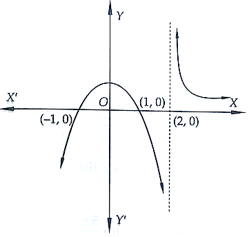
Let A denote the required area. Then,
$A=\int\limits_{0}^{3/2}f(x)dx$
$⇒A=\int\limits_0^1f(x)dx+\left|\int\limits_{1}^{3/2}f(x)dx\right|$
$⇒A=\int\limits_0^1\frac{(x-1)(x+1)}{x-2}dx-\int\limits_{1}^{3/2}\frac{(x-1)(x+1)}{x-2}dx$
$⇒A=\int\limits_0^1\left(x+2+\frac{3}{x-2}\right)dx-\int\limits_{1}^{3/2}\left(x+2+\frac{3}{x-2}\right)dx$
$⇒A=[\frac{(x+2)^2}{2}+3\log|x-2|]_0^1-[\frac{(x+2)^2}{2}+3\log|x-2|]_{1}^{3/2}$
$⇒A=\left(\frac{9}{2}-2-3\log 2\right)\left[\left(\frac{49}{8}+3\log \frac{1}{2}\right)-\frac{9}{2}\right]=\frac{7}{8}$ sq. units.