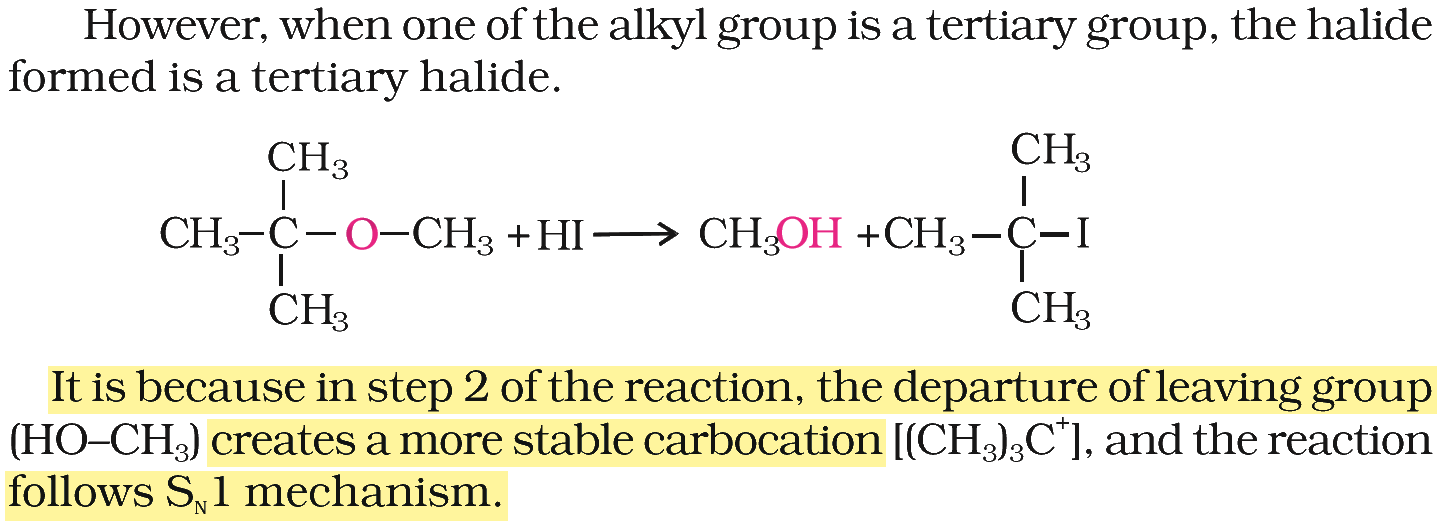
In the reaction, (CH3)3C – O – CH3 + HI → Products
CH3OH and (CH3)3CI are the products and not CH3I and (CH3)3C – OH. It is because,
(A) in step 2 of the reaction the departure of leaving group (HO – CH3) creates less stable carbocation.
(B) in step 2 of the reaction the departure of leaving group (HO – CH3) creates more stable carbocation.
(C) the reaction follows SN1 mechanism.
(D) the reaction follows SN2 mechanism.
Choose the correct answer from the options given below :
Answer & explanation
Correct answer: option 2
The correct answer is Option (2) → (B) and (C) only
Ethers are cleaved by HI. First the ether oxygen is protonated. What happens next depends on the alkyl groups: with primary or secondary groups, iodide attacks the less substituted carbon by SN2; but when one group is tertiary, the protonated ether loses a molecule of alcohol and forms a stable tertiary carbocation, which then combines with iodide (SN1).
\( \displaystyle \ce{(CH3)3C-O-CH3 + H+ -> (CH3)3C-O^+(H)-CH3} \)
\( \displaystyle \ce{(CH3)3C-O^+(H)-CH3 -> (CH3)3C+ + HO-CH3} \)
\( \displaystyle \ce{(CH3)3C+ + I^- -> (CH3)3C-I} \)
(A) … the departure of leaving group (HO – \( \ce{CH3} \)) creates less stable carbocation. — Incorrect. The carbocation formed is the tertiary \( \ce{(CH3)3C+} \), the most stable kind.
(B) … the departure of leaving group (HO – \( \ce{CH3} \)) creates more stable carbocation. — Correct. Methanol leaves and the stable tertiary carbocation is formed, which is why the iodine ends up on the tertiary carbon.
(C) the reaction follows SN1 mechanism. — Correct. The rate depends on the formation of the carbocation, an SN1 path.
(D) the reaction follows SN2 mechanism. — Incorrect. An SN2 attack would be on the less hindered methyl carbon and would give \( \ce{CH3I} \) and \( \ce{(CH3)3C-OH} \), which are not the products.
NCERT (2026-27 edition):
Cleavage of C–O Bond in Ethers – …