Amita is a student council member of her school who takes her commitment towards environmental preservation very seriously. She organises various plantation drives and also is in charge of the school recycle plant. She gets very upset and sad when she sees people wasting or misusing paper or cutting trees. Her parents are also famous environmentalists who campaigned for a ban of plastics in the hill areas. They always praised and motivated Amita to continue to be a pro-environment person.
Identify the affective component of Amita's attitude towards environment.
Answer & explanation
Correct answer: option 1
The correct answer is Option (1) → Upset and Sad
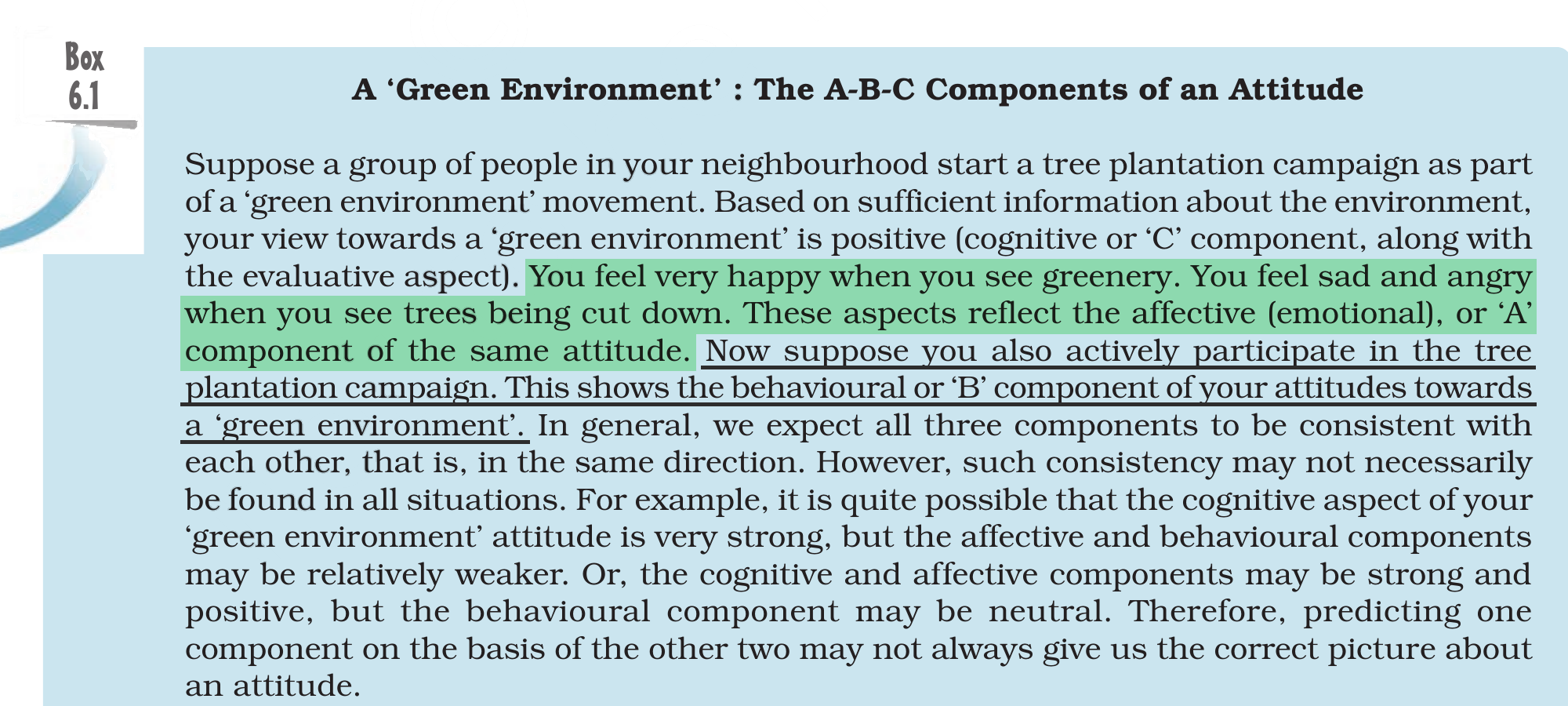
Option (1) Upset and Sad — Correct. The affective component is the emotional part of an attitude. Feeling sad and angry when trees are cut down reflects the ‘A’ component of a ‘green environment’ attitude, and Amita gets very upset and sad when she sees paper wasted or trees cut.
Option (2) School recycle plant — Incorrect. Managing the recycle plant is something Amita does, so it belongs to the behavioural component, the tendency to act. It is not a feeling.
Option (3) Commitment towards environment — Incorrect. Her commitment is the stand she takes: the view that the environment must be preserved, which she carries into action. The question asks for the emotion, and the passage names her emotions in so many words: upset and sad.
Option (4) Praise and motivation — Incorrect. Praise and motivation come from her parents. They explain how she learnt the attitude (by being rewarded); they are not her own feelings towards the environment.
NCERT (2025-26): “Nature and Components of Attitudes … All definitions of attitudes agree that an attitude is a state of the mind, a set of views, or thoughts, regarding some topic (called the ‘attitude object’), which have an evaluative feature (positive, negative or neutral quality). It is accompanied by an emotional component, and a tendency to act in a particular way with regard to the attitude object. The thought component is referred to as the cognitive aspect, the emotional component is known as the affective aspect, and the tendency to act is called the behavioural (or conative) aspect.…”
|