
In aldehydes, the carbonyl group is bonded to a carbon and hydrogen, while in ketones it is bonded to two carbon atoms. The compounds in which the carbonyl group is bonded to oxygen are known as carboxylic acids and their derivatives.
Identify A
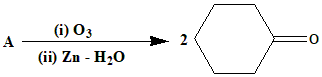
Answer & explanation
Correct answer: option 3
The correct answer is Option (3) → Cyclohexylidenecyclohexane (two rings joined by a C=C bond)
Ozonolysis followed by Zn/\( \ce{H2O} \) cuts a C=C bond and puts an oxygen on each of the two carbons. Working backwards, the two C=O groups of the products are joined to make the C=C bond of A.
The products are 2 molecules of cyclohexanone. Joining their carbonyl carbons by a double bond gives one cyclohexane ring linked to another by a C=C bond:
\( \ce{(C6H10)C=C(C6H10)} \xrightarrow[\text{(ii) Zn/}\ce{H2O}]{\text{(i) }\ce{O3}} \ce{2C6H10O} \) (cyclohexanone)
This is the structure in Option (3).
Why the other options are incorrect
Option (1) bicyclohexyl — Incorrect. The two rings are joined by a C–C single bond; it has no C=C bond, so ozone does not react with it.
Option (2) cyclohexylidene attached to a benzene ring — Incorrect. The right-hand ring is drawn as a benzene-type ring with its own double bonds; cleaving it cannot give a second cyclohexanone, so the products would not be 2 cyclohexanone.
Option (4) methylenecyclohexane — Incorrect. Ozonolysis gives cyclohexanone + HCHO (formaldehyde), i.e. only one molecule of cyclohexanone.
NCERT (2026-27 edition):
By Ozonolysis of Alkenes
