
CUETMOCK
  • Pricing
  • Mentors
Log inStart freeStart free mocks→

First test, then trust

Try a free CUET mock test.

Join 5,00,000+ students who rehearsed exam day on the exact NTA screen before sitting CUET. On the web and on Android.

Start free mocks →Get the Android app
CUETMOCK

India's #1 CUET Mock Test Platform. Original NCERT-based questions on the exact NTA exam screen — trusted by 5,00,000+ students since CUET 2022.

Get it onGoogle PlayScan to download the CUETMOCK app

Mock tests

  • CUET mock test series
  • Browse all papers
  • Commerce mocks
  • Humanities (Arts) mocks
  • Science mocks
  • Languages & GAT mocks
  • Free practice questions
  • Pricing

Resources

  • CUET exam guide
  • CUET syllabus
  • Universities accepting CUET
  • Expert blogs
  • News & notifications
  • Webinars & counselling
  • CUET score calculator
  • How we estimate your rank
  • FAQs

Company

  • About us
  • Our leadership & team
  • Our toppers
  • Mentors
  • For schools
  • Contact us
  • Terms
  • Privacy
  • Refund policy

Talk to us

+91 7696 6630 56info@cuetmock.comWhatsApp us

Our other platforms

  • JEE Mock — For IIT-JEE aspirants
  • NEET Mock — For NEET aspirants

Newsletter

Exam updates, study material and offers — no spam.

© 2026 NYC Ventures Pvt. Ltd.

701-702, Royal Business Park, Zirakpur, Punjab - 140603

  • Terms of use
  • Privacy policy
  • Refund policy
  • Contact us

iCUETMOCK is an independent preparation platform, not affiliated with the National Testing Agency (NTA). Always check exam details on the official NTA website.

  • Home
  • Mock tests
  • CUET guide
  • Pricing
  • Log in
Home/Practice questions/General Aptitude Test
General Aptitude TestQuantitative ReasoningCo-ordinate Geometry

In what ratio does the x-axis divide the line segment joining A(2, -6…

In what ratio does the x-axis divide the line segment joining \(A(2,\,-6)\) and \(B(7,\,3)\)?

Answer & explanation+

Correct answer: option 1

The correct answer is Option (1) → 2 : 1

Let the x-axis cut AB at R in the ratio \(k:1\). R is on the x-axis, so the y-coordinate of R is 0.

  • y-coordinate of R by the section formula: \(\displaystyle \frac{k\times3+1\times(-6)}{k+1}\)

  • \(\displaystyle \frac{3k-6}{k+1}=0\), so \(3k-6=0\)

  • \(k=2\), so the ratio is \(2:1\)

  • Check: A is 6 units below the x-axis and B is 3 units above it, and \(6:3=2:1\)
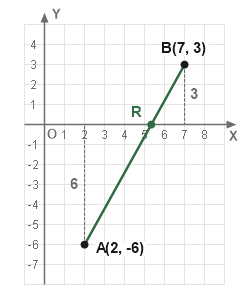
Figure for the solution

Advertisement

Practise more on Quantitative Reasoning

Chapter-wise mocks on the real NTA exam screen, with solutions and your rank. Your first mocks are free.

Start free mocks →

Advertisement

Next questions

  1. Let A and B be two square matrices of the same order. Which of the following is not true regarding transpose of matrices.Maths. Section B1 · Matrices
  2. When a fire brigade arrives, why does it pour water on the burning material?General Aptitude Test · General Knowledge
  3. The buildings of which of the following states have received the International Green Apple Awards for Beautiful Buildings award in 2023?General Aptitude Test · Current Affairs
  4. What was François Sisten's profession?A) MagistrateB) Police inspectorC) Rebel leaderD) TahsildarHistory · Modern India: Rebels and the Raj
  5. Statement I: The components of an ecosystem do not include decomposition. Statement II: Decomposers break down complex organic matter into…Biology · Ecosystem
  6. The base of a pyramid is a regular polygon, whose total surface area is 340 sq. cm and area of base is 100sq. cm. If area of each lateral s…General Aptitude Test · Quantitative Reasoning
  7. In an economy without a government, ex ante aggregate demand for final goods is the sum of:Economics · Macro Economics: Determination of Income and Employment
  8. What is the Q-factor of the given circuit?Physics · Alternating Current
  9. 'पागलपन' शब्द में प्रयुक्त प्रत्यय है-Hindi · प्रत्यय
  10. Match List I with List II LIST ILIST IIA. Zhou EnlaiI. Four ModernisationsB. Deng XiaopingII. 1982C. Privatization of AgricultureIII. 1998D…Political Science · Contemporary World Politics: Contemporary Centres of power