
Name the duct through which milk is sucked out ?
Answer & explanation
Correct answer: option 3
The correct answer is Option (3) → Lactiferous duct.
A functional mammary gland is characteristic of all female mammals. The mammary glands are paired structures (breasts) that contain glandular tissue and a variable amount of fat.
The glandular tissue of each breast is divided into 15-20 mammary lobes containing clusters of cells called alveoli.
The cells of alveoli secrete milk, which is stored in the cavities (lumens) of alveoli. The alveoli open into mammary tubules. The tubules of each lobe join to form a mammary duct.
Several mammary ducts join to form a wider mammary ampulla which is connected to the lactiferous duct through which milk is sucked out.
The lactiferous ducts are the structures through which milk is transported from the mammary glands to the nipple.
Milk is produced in the mammary alveoli (Option 4), then flows through the mammary ducts (Option 1) and collects in the lactiferous sinuses, which connect to the lactiferous ducts.
The lactiferous ducts open at the nipple, allowing milk to be sucked out.
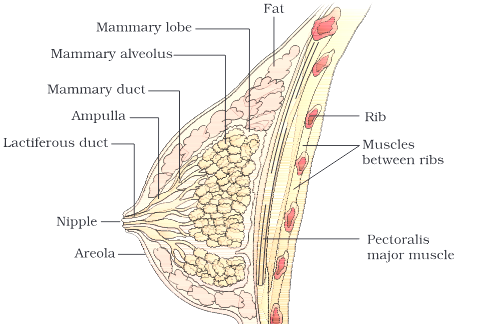
A diagrammatic sectional view of Mammary gland