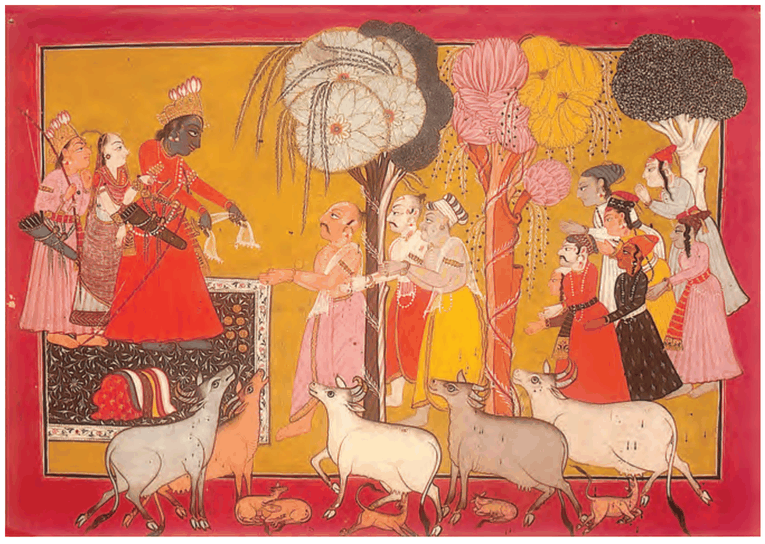
Read the passage and observe the painting.
Rama learns of his exile and prepares to leave Ayodhya along with his wife Sita and brother Lakshmana. Maintaining equanimity of mind, Rama indulges in his last acts of giving away his possessions. At the request of Rama, his brother piles up his belongings and the crowd begins to gather to receive the largesse of their beloved Rama — jewellery, sacrificial vessels, thousand cows and other treasures.
The set to which this painting belongs takes its name from Shangri. Who lived at Shangri?
Answer & explanation
Correct answer: option 1
The correct answer is Option (1) → A branch of the Kullu royal family
Option (1) A branch of the Kullu royal family — Correct. Shangri was the place of residence of a branch of the Kullu royal family, the patrons and former owners of this set.
Option (2) A branch of the Kangra royal family — Incorrect. Guler was a high-ranking branch of the Kangra royal family, where the Guler–Kangra phase first appeared; it is not Shangri.
Option (3) A branch of the Jasrota royal family — Incorrect. Jasrota is known for Nainsukh’s portraits of its ruler Raja Balwant Singh; the Shangri set belongs to Kullu.
Option (4) A branch of the Basohli royal family — Incorrect. Basohli is where the Pahari style began; the Shangri set was made by Kullu artists who drew on the Basohli style.
NCERT (2026-27): “Basohli School …The Sanskrit epic, Ramayana, was one of the favourite texts of the hill artists at Basohli, as well as, Kullu. This set derives its name from ‘Shangri’, the place of residence of a branch of the Kullu royal family, patrons and formerly possessors of this set. These works of Kullu artists were influenced in varying degrees by the styles of Basohli and Bilaspur.”
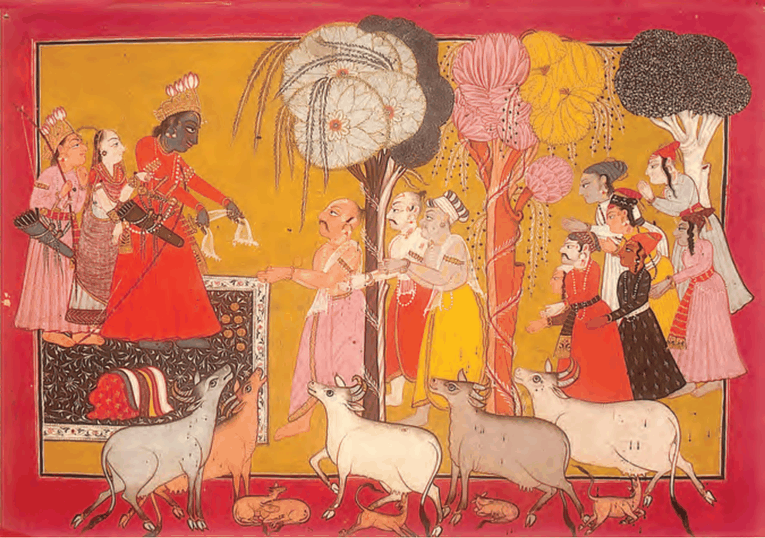
“Rama gives away his possessions, Ayodhya Kanda, Shangri Ramayana, 1690–1700, Los Angeles County Museum of Art, USA” |