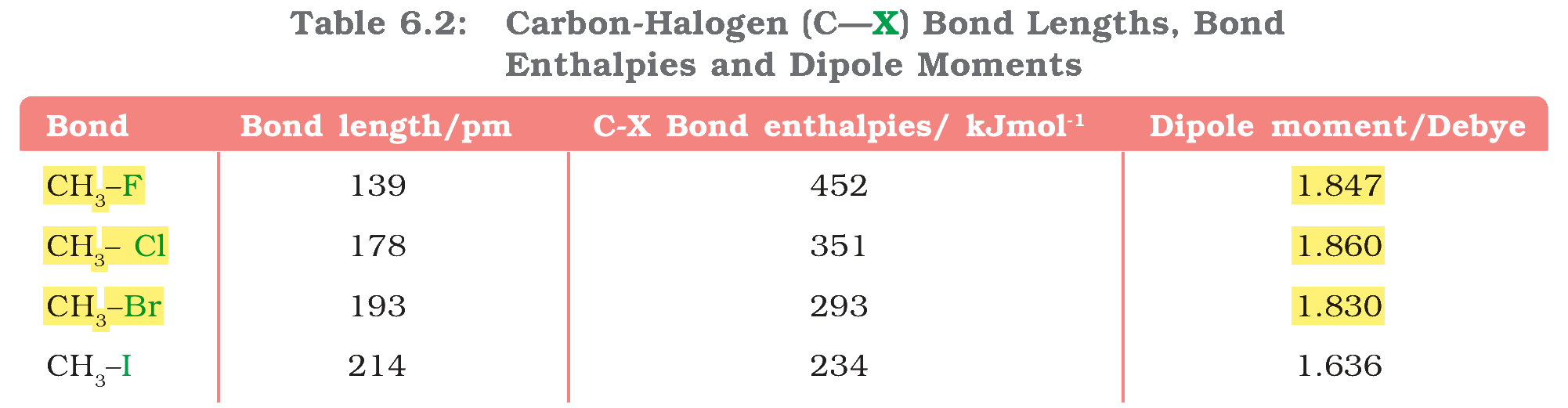
Which of the following shows the correct decreasing order of dipole moment?
Answer & explanation
Correct answer: option 2
The correct answer is Option (2) → CH3Cl > CH3F > CH3Br
The dipole moment of a C–X bond is the product of the charge separated and the bond length. Down the group the halogen becomes less electronegative (smaller charge) but larger (longer bond), so the two effects work against each other.
\( \ce{CH3Cl} \) — high polarity with a fairly long bond (178 pm): 1.860 D, first.
\( \ce{CH3F} \) — the most polar bond, but the shortest (139 pm): 1.847 D, second.
\( \ce{CH3Br} \) — the longest of the three bonds (193 pm), but the least polar: 1.830 D, third.
NCERT (2026-27 edition):
6.3 Nature of C-X Bond – “As we go down the group in the periodic table, the size of halogen atom increases. Fluorine atom is the smallest and iodine atom is the largest. Consequently the carbon-halogen bond length also increases from C–F to C–I. Some typical bond lengths, bond enthalpies and dipole moments are given in Table 6.2.”
Table 6.2: Carbon-Halogen (C—X) Bond Lengths, Bond Enthalpies and Dipole Moments