What types of bond (linkage) are present in nucleotide?
Answer & explanation
Correct answer: option 3
The correct answer is Option (3) → Phosphodiester linkage
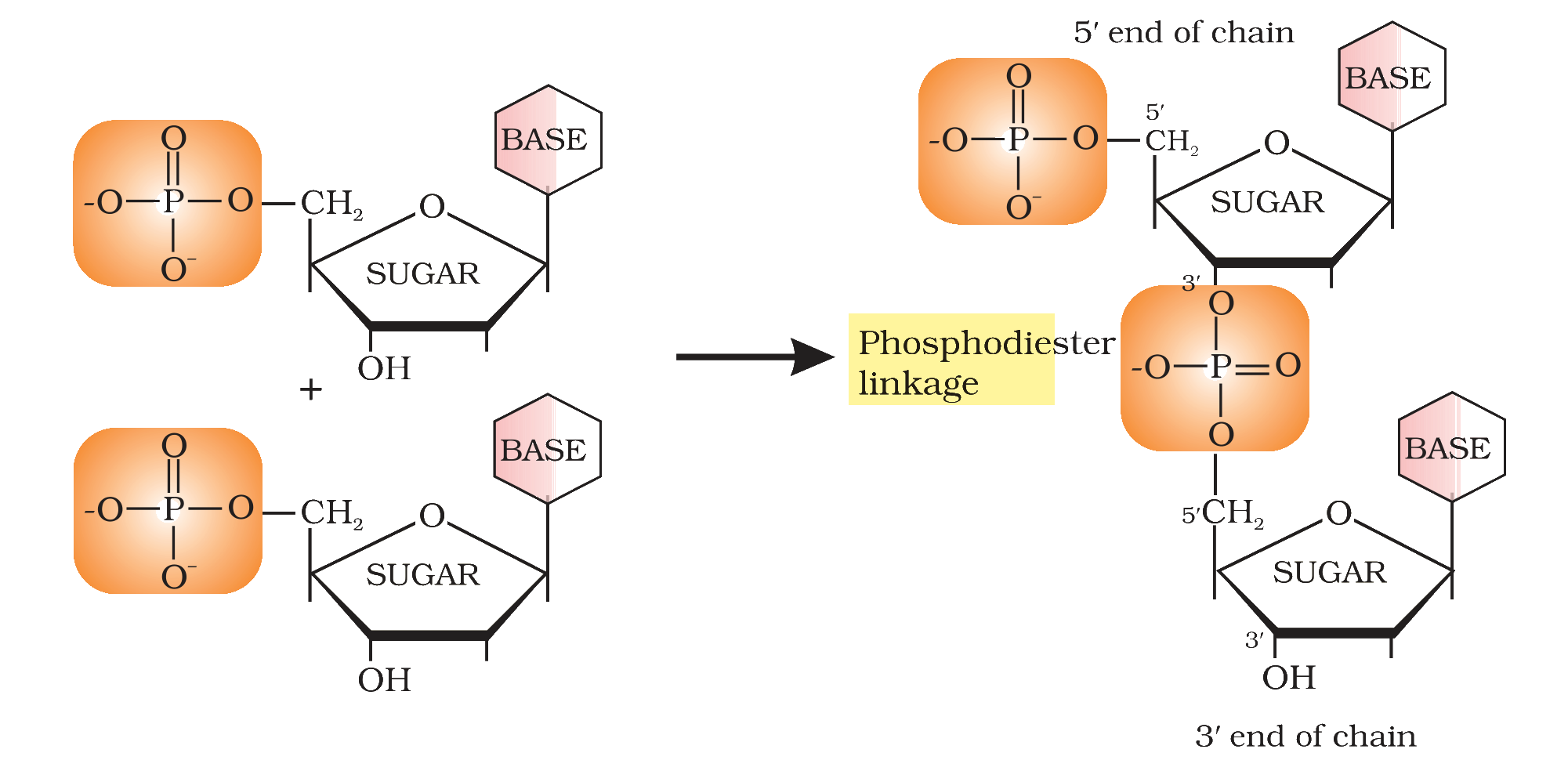
A nucleotide has three parts: a nitrogenous base, a pentose sugar (ribose in RNA, 2-deoxyribose in DNA) and a phosphate group. The base is joined to C1′ of the sugar, giving a nucleoside, and the phosphoric acid is esterified with the –OH at C5′ of the sugar, giving the nucleotide.
In nucleic acids the nucleotides are linked through these phosphate groups. The phosphate attached to C5′ of one sugar forms a second ester bond with the –OH at C3′ of the next sugar. A phosphate joined by two ester bonds is a phosphodiester linkage:
\( \displaystyle \text{C3}'\text{ of one sugar}\ \ce{-O-P(O)(OH)-O-}\ \text{C5}'\text{ of the next sugar} \)
So the linkage that holds nucleotides together in DNA and RNA is the phosphodiester linkage.
Why the other options are incorrect
Option (1) Peptide linkage — Incorrect. The \( \ce{-CO-NH-} \) bond joins amino acids in proteins; nucleotides have no amino acid units.
Option (2) Ionic bond — Incorrect. The units of a nucleic acid are joined by covalent ester bonds; the two strands of DNA are held together by hydrogen bonds between the bases, not by ionic bonds.
Option (4) O-glycosidic linkage — Incorrect. An O-glycosidic linkage joins monosaccharide units in disaccharides and polysaccharides. In a nucleotide the base is joined to the sugar through nitrogen, by an N-glycosidic bond.
NCERT (2026-27 edition):
Structure of Nucleic Acids – …