Which of the following polymers are obtained by chain growth polymerisation?
(A) Orlon
(B) Nylon
(C) Teflon
(D) Nylon 2 - nylon 6
(E) Dacron
Choose the correct answer from the options given below:
Answer & explanation
Correct answer: option 2
The correct answer is Option (2) → A, C only
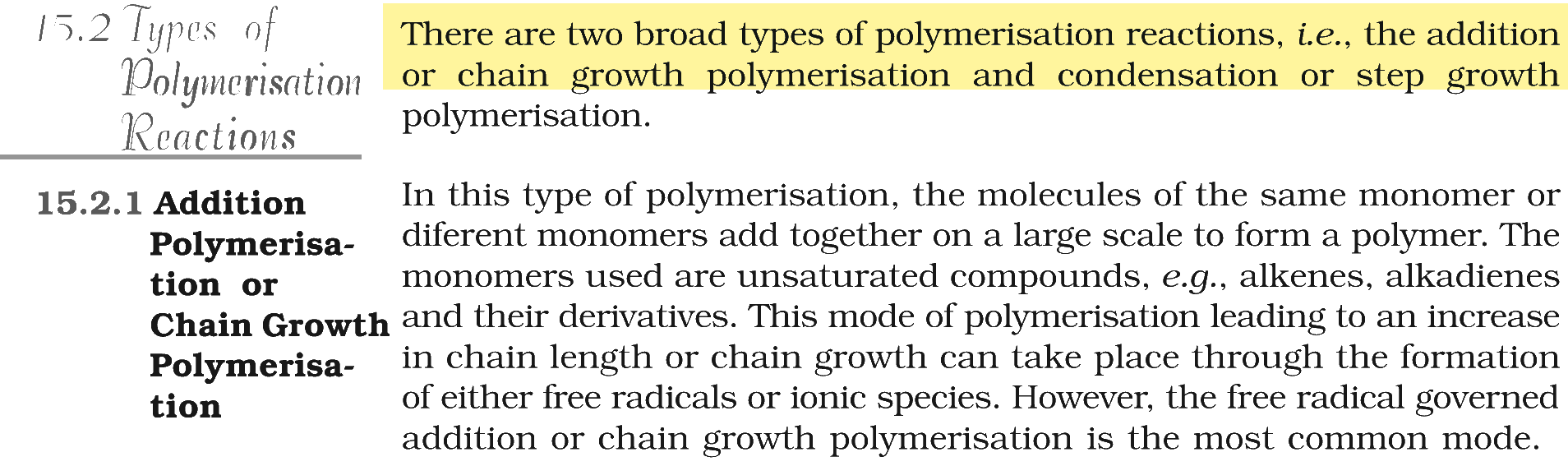
Chain growth (addition) polymers come from monomers with C=C bonds; step growth (condensation) polymers come from bifunctional monomers that lose small molecules such as water.
(A) Orlon — Correct. Polyacrylonitrile, made by addition polymerisation of acrylonitrile:
\( \displaystyle n\,\ce{CH2=CHCN} \xrightarrow{\text{peroxide catalyst}} \ce{-(CH2-CH(CN))_{n}-} \)
(B) Nylon — Incorrect. Nylons (e.g. nylon 6,6) are polyamides formed by condensation.
(C) Teflon — Correct. Made by addition polymerisation of tetrafluoroethene:
\( \displaystyle n\,\ce{CF2=CF2} \xrightarrow[\text{high pressure}]{\text{catalyst}} \ce{-(CF2-CF2)_{n}-} \)
(D) Nylon 2 - nylon 6 — Incorrect. A polyamide of glycine and aminocaproic acid, formed by condensation.
(E) Dacron — Incorrect. A polyester of ethane-1,2-diol and terephthalic acid, formed by condensation.
Note: This question is from the pre-rationalised NCERT book (2022-23). The topic is not there in the latest NCERT book (2026-27), and it is also out of the CUET 2026 syllabus.
NCERT (Pre-rationalised edition, 2022-23):
Types of Polymerisation Reactions