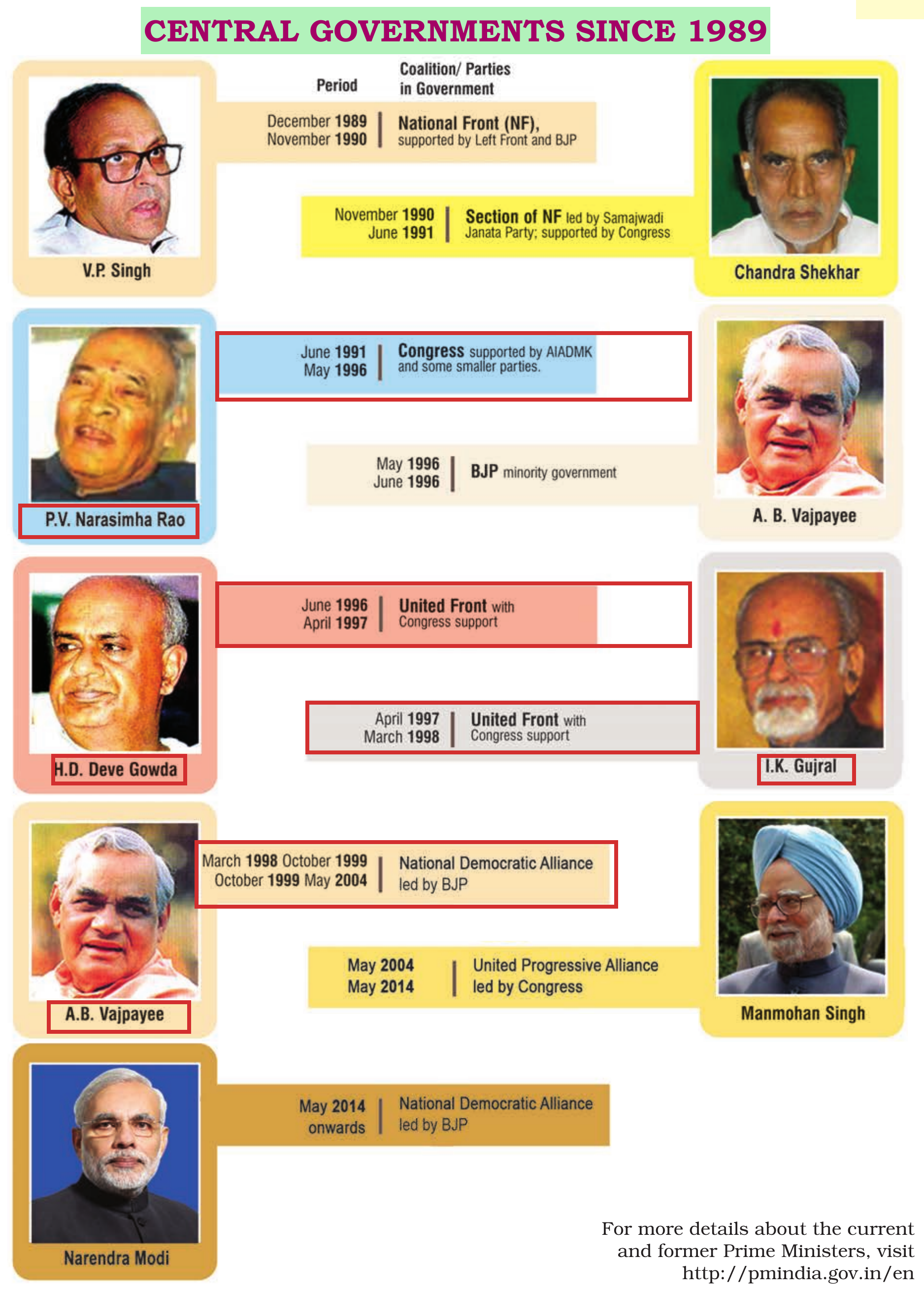
Match List-I with List-II
| List-I | List-II |
| (A) I.K. Gujral | (I) Congress (June 1991-May 1996) |
| (B) A.B. Vajpayee | (II) United Front (June 1996-April 1997) |
| (C) H.D. Deve Gowda | (III) United Front (April 1997-March 1998) |
| (D) P.V. Narsimha Rao | (IV) NDA (March 1998-October 1999, October 1999-May 2004) |
Choose the correct answer from the options given below:
Answer & explanation
Correct answer: option 4
The correct answer is Option (4) → (A)-(III), (B)-(IV), (C)-(II), (D)-(I)
(A) I.K. Gujral — this matches (III) United Front (April 1997-March 1998).
(B) A.B. Vajpayee — this matches (IV) NDA (March 1998-October 1999, October 1999-May 2004).
(C) H.D. Deve Gowda — this matches (II) United Front (June 1996-April 1997).
(D) P.V. Narsimha Rao — this matches (I) Congress (June 1991-May 1996).
NCERT (2026-27): “Alliance politics … Thus, with the elections of 1989, a long phase of coalition politics began in India. Since then, there have been eleven governments at the Centre, all of which have either been coalition governments or minority governments supported by other parties, which did not join the government. In this new phase, any government could be formed only with the participation or support of many regional parties. This applied to the National Front in 1989, the United Front in 1996 and 1997, the BJP-led coalition in 1998, the NDA in 1999, the UPA in 2004 and 2009. However, this trend changed in 2014.…”
|