
Refer to the LPP given by \( Z=2.5x+y \), subject to constraints \( 3x+y\le 12;\ 3y+x\le 12;\ x,y\ge 0 \):
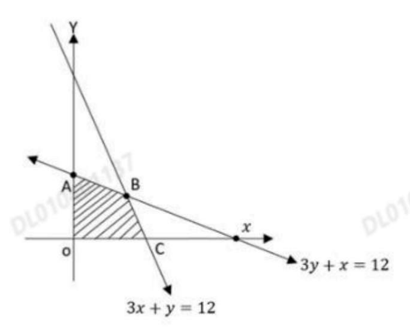
In the given figure, If \( Z_A \) = value of Z at A, \( Z_C \) = value of Z at C and Max.(Z) = maximum value of Z, then which of the following relations between \( Z_A \), \( Z_C \) and Max.(Z) are correct ?
A. \( 2Z_A=5\,\mathrm{Max.}(Z) \)
B. \( 5Z_A=2Z_C \)
C. \( Z_A=6+Z_C \)
D. \( 6+Z_A=Z_C \)
Choose the correct answer from the options given below:
Answer & explanation
Correct answer: option 3
The correct answer is Option (3) → B and D only
From the figure, A is on the y-axis, C is on the x-axis and B is where the two lines meet.
A: 3y + 0 = 12 gives A(0, 4).
C: 3x + 0 = 12 gives C(4, 0).
B: solving 3x + y = 12 and x + 3y = 12 gives x = y = 3, so B(3, 3).
Values of Z = 2.5x + y at the corner points:
At O(0, 0): Z = 0
At A(0, 4): Z = 4
At B(3, 3): Z = 7.5 + 3 = 10.5
At C(4, 0): Z = 10
So \( Z_A=4 \), \( Z_C=10 \) and Max.(Z) = 10.5.
Checking the statements
(A) \( 2Z_A=5\,\mathrm{Max.}(Z) \) — Incorrect. 2 × 4 = 8, but 5 × 10.5 = 52.5.
(B) \( 5Z_A=2Z_C \) — Correct. 5 × 4 = 20 and 2 × 10 = 20.
(C) \( Z_A=6+Z_C \) — Incorrect. \( Z_A \) is 4, but 6 + 10 = 16.
(D) \( 6+Z_A=Z_C \) — Correct. 6 + 4 = 10, which is \( Z_C \).