CUETMOCK
  • Pricing
  • Mentors
Log inStart freeStart free mocks→

First test, then trust

Try a free CUET mock test.

Join 5,00,000+ students who rehearsed exam day on the exact NTA screen before sitting CUET. On the web and on Android.

Start free mocks →Get the Android app
CUETMOCK

India's #1 CUET Mock Test Platform. Original NCERT-based questions on the exact NTA exam screen — trusted by 5,00,000+ students since CUET 2022.

Get it onGoogle PlayScan to download the CUETMOCK app

Mock tests

  • CUET mock test series
  • Browse all papers
  • Commerce mocks
  • Humanities (Arts) mocks
  • Science mocks
  • Languages & GAT mocks
  • Free practice questions
  • Pricing

Resources

  • CUET exam guide
  • CUET syllabus
  • Universities accepting CUET
  • Expert blogs
  • News & notifications
  • Webinars & counselling
  • CUET score calculator
  • How we estimate your rank
  • FAQs

Company

  • About us
  • Our leadership & team
  • Our toppers
  • Mentors
  • For schools
  • Contact us
  • Terms
  • Privacy
  • Refund policy

Talk to us

+91 7696 6630 56info@cuetmock.comWhatsApp us

Our other platforms

  • JEE Mock — For IIT-JEE aspirants
  • NEET Mock — For NEET aspirants

Newsletter

Exam updates, study material and offers — no spam.

© 2026 NYC Ventures Pvt. Ltd.

701-702, Royal Business Park, Zirakpur, Punjab - 140603

  • Terms of use
  • Privacy policy
  • Refund policy
  • Contact us

iCUETMOCK is an independent preparation platform, not affiliated with the National Testing Agency (NTA). Always check exam details on the official NTA website.

  • Home
  • Mock tests
  • CUET guide
  • Pricing
  • Log in
Home/Practice questions/General Aptitude Test
General Aptitude TestVerbal ReasoningSyllogism

Two statements are given, followed by three conclusions numbered I, I…

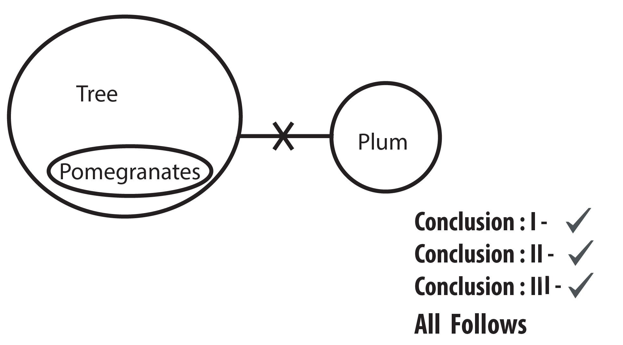
Two statements are given, followed by three conclusions numbered I, II and III. Assuming the statements to be true, even if they seem to be at variance with commonly known facts, decide which of the conclusions logically follow(s)from the statements.

Statements:

No tree is a plum.

All pomegranates are trees.

Conclusions:

I. No pomegranate is a plum.

II. No plum is a tree.

III. Some trees are pomegranates.

Answer & explanation+

Correct answer: option 1

Advertisement

Practise more on Verbal Reasoning

Chapter-wise mocks on the real NTA exam screen, with solutions and your rank. Your first mocks are free.

Start free mocks →

Advertisement

Next questions

  1. In which technique, the removal of anthers from the bisexual flower bud takes place before the anther dehisce ?Biology · Sexual Reproduction in Flowering Plants
  2. Select the most appropriate meaning of the underlined idiom in the given sentence. In times of economic recession, the demand for goods is…English · Grammar: Idioms
  3. In how many least number of complete years a sum of money become more than four times of itself at the rate of 50 percent per annum on simp…General Aptitude Test · Numerical Ability
  4. Select the most appropriate word to fill in the blank. The company ______ its first all electric car in the Indian market soon.English · Fill Blanks
  5. A man purchased 120 exercise books at the rate of ₹30 each. He sold 1/3 of them at the rate of ₹40 each, 1/2 of them at the rate of ₹50 eac…General Aptitude Test · Numerical Ability
  6. Fill in the blanks in List-I with the appropriate words given in List-II.List-I (Sentences)List-II (Words)(A) Please ______ that all the ga…English · Homonyms
  7. What is the coordination number of Ag in [Ag(CN)2]- ion?Chemistry · Inorganic: Coordination Compounds
  8. Which of the following statements about Political Theory is incorrect?Political Science · Political Theory: An Introduction
  9. Find the compound interest on ₹1,60,000 at 10% per annum for 2 years if the interest is compounded half-yearly.General Aptitude Test · Numerical Ability
  10. In May 1977, the Janata party government appointed a Commission of Inquiry to look "into several aspects of allegations of abuse of authori…Political Science · Politics in India Since Independence: Crisis of democratic Order