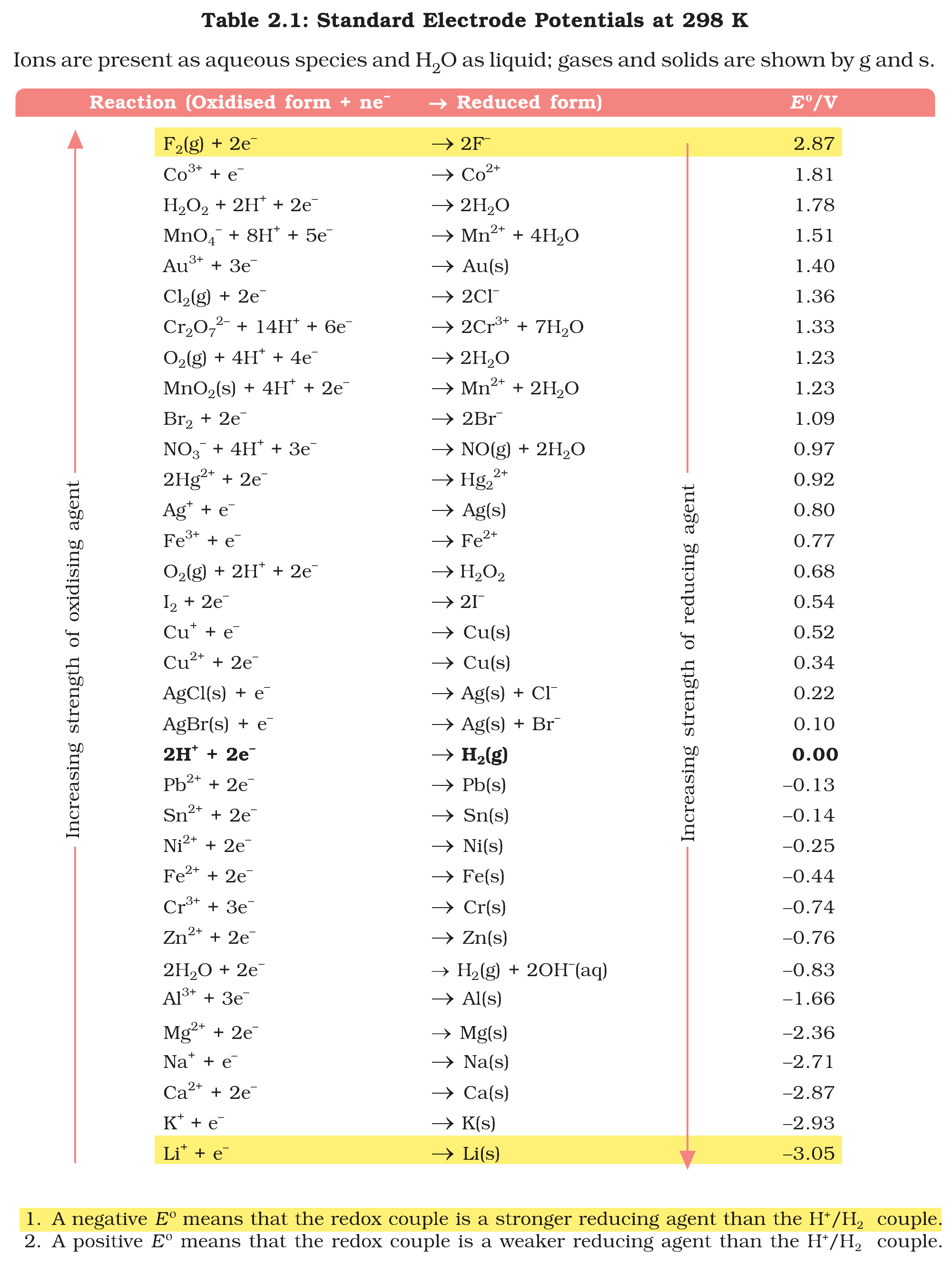
Consider the following statements about the standard electrode potentials of half-cell reduction reactions at 298 K.
(A) Fluorine gas has the maximum tendency to get reduced, so fluorine gas is the strongest oxidising agent and fluoride ion is the weakest reducing agent.
(B) Lithium has the lowest standard electrode potential, so lithium ion is the strongest oxidising agent in aqueous solution.
(C) As the standard electrode potential decreases, the oxidising power of the species on the left of the reaction decreases and the reducing power of the species on the right increases.
(D) A negative standard electrode potential means that the redox couple is a weaker reducing agent than the H+/H2 couple.
Which of the statements given above are correct? Choose the correct answer from the options given below:
Answer & explanation
Correct answer: option 1
The correct answer is Option (1) → (A) and (C) only
A higher (more positive) E° means a greater tendency of the species on the left to be reduced, so it is a stronger oxidising agent; a lower E° means the species on the right is more easily oxidised, so it is a stronger reducing agent.
(A) Fluorine gas has the maximum tendency to get reduced, so fluorine gas is the strongest oxidising agent and fluoride ion is the weakest reducing agent. — True. F2/F− has the highest E° (2.87 V) of all the couples.
(B) Lithium has the lowest standard electrode potential, so lithium ion is the strongest oxidising agent in aqueous solution. — False. With the lowest E° (−3.05 V), Li+ has the least tendency to be reduced, so lithium ion is the weakest oxidising agent, while lithium metal is the most powerful reducing agent.
(C) As the standard electrode potential decreases, the oxidising power of the species on the left of the reaction decreases and the reducing power of the species on the right increases. — True. This is the trend from the top to the bottom of the table of standard electrode potentials.
(D) A negative standard electrode potential means that the redox couple is a weaker reducing agent than the H+/H2 couple. — False. A couple with negative E° lies below hydrogen (0.00 V), so it is a stronger reducing agent than the H+/H2 couple; a positive E° means a weaker one.
NCERT (2026-27 edition):
2.2.1 Measurement of Electrode Potential – “…It can be seen that the standard electrode potential for fluorine is the highest in the Table indicating that fluorine gas (F2) has the maximum tendency to get reduced to fluoride ions (F–) and therefore fluorine gas is the strongest oxidising agent and fluoride ion is the weakest reducing agent. Lithium has the lowest electrode potential indicating that lithium ion is the weakest oxidising agent while lithium metal is the most powerful reducing agent in an aqueous solution. It may be seen that as we go from top to bottom in Table 2.1 the standard electrode potential decreases and with this, decreases the oxidising power of the species on the left and increases the reducing power of the species on the right hand side of the reaction.”
“1. A negative Eo means that the redox couple is a stronger reducing agent than the H+/H2 couple.”
Table 2.1: Standard Electrode Potentials at 298 K