
Arrange the following in the increasing order of pKb in aqueous phase
(A) C6H5NH2
(B) C2H5NH2
(C) (C2H5)2NH
(D) NH3
Choose the correct answer from the options given below:
Answer & explanation
Correct answer: option 3
The correct answer is Option (3) → (C), (B), (D), (A)
pKb measures basic strength inversely: the stronger the base, the smaller its pKb. So the increasing order of pKb is the same as the decreasing order of basic strength.
An amine is basic because the lone pair on nitrogen can accept a proton. In water, three factors decide the basic strength of aliphatic amines:
Inductive effect (+I): alkyl groups push electrons towards nitrogen: 3° > 2° > 1°.
Solvation: the protonated amine is stabilised by hydrogen bonding with water; more N–H hydrogens give better stabilisation: 1° > 2° > 3°.
Steric hindrance: bulky groups hinder this hydrogen bonding, which again favours 1° > 2° > 3°.
In aromatic amines, the lone pair on nitrogen is delocalised into the benzene ring by resonance. It is much less available for a proton, so aniline is a weaker base than ammonia.
For the compounds given here, the order of basic strength in water is:
\( \displaystyle 2^\circ\text{ amine} > 1^\circ\text{ amine} > \ce{NH3} > \text{aryl amine} \)
\( \displaystyle \ce{(C2H5)2NH} > \ce{C2H5NH2} > \ce{NH3} > \ce{C6H5NH2} \)
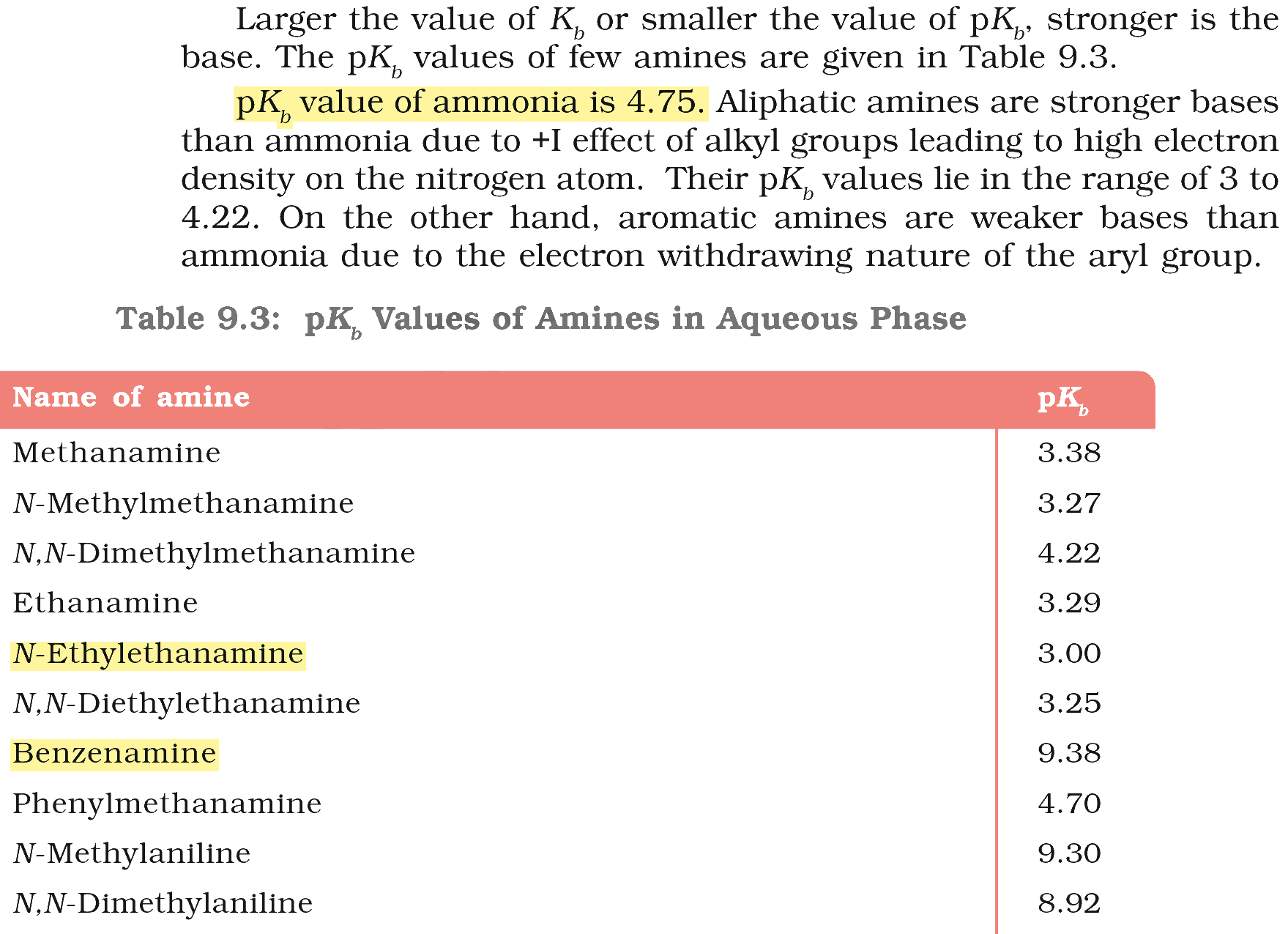
\( \displaystyle \mathrm{p}K_b:\ 3.00 < 3.29 < 4.75 < 9.38 \)
Matching the given compounds:
(C) \( \ce{(C2H5)2NH} \): diethylamine (2°)
(B) \( \ce{C2H5NH2} \): ethylamine (1°)
(D) \( \ce{NH3} \): ammonia
(A) \( \ce{C6H5NH2} \): aniline (aryl amine)
NCERT (2026-27 edition):
Basic Character of Amines – …
Note: The same/similar question has been asked in different years by NTA as per the details given below:
| 2026 | 2025 | 2024 | 2023 | 2022 |
|---|---|---|---|---|
| 22-05 S2 11-05 S1 | 21-05 S1 16-05 S1 | – | – | – |