Given the production function \( f(tx_1, tx_2) > t.f (x_1, x_2) \), what it exhibit:
Answer & explanation
Correct answer: option 1
The correct answer is Option (1) → Increasing returns to scale.
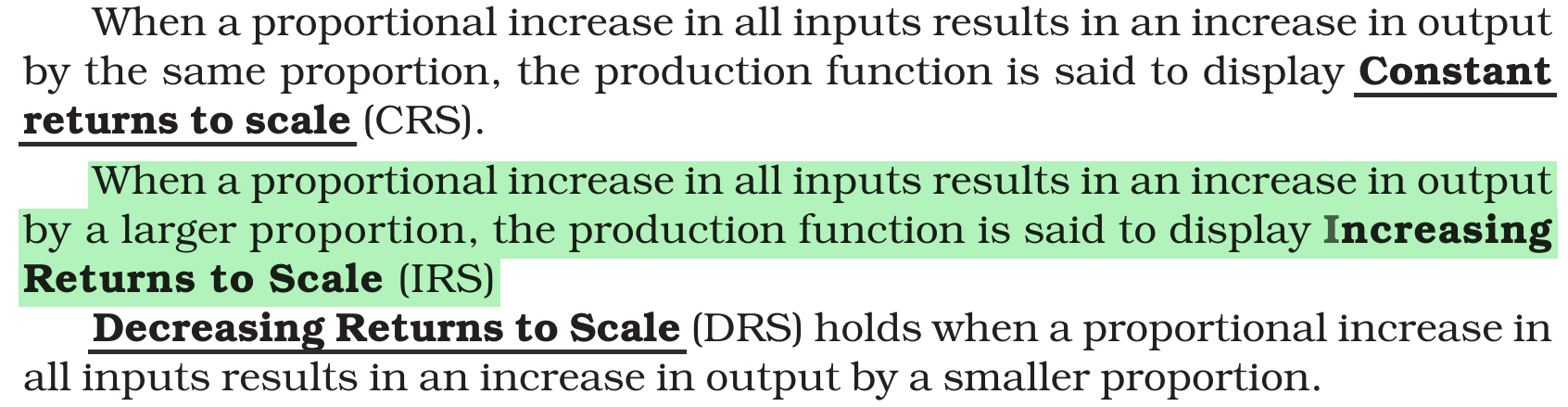
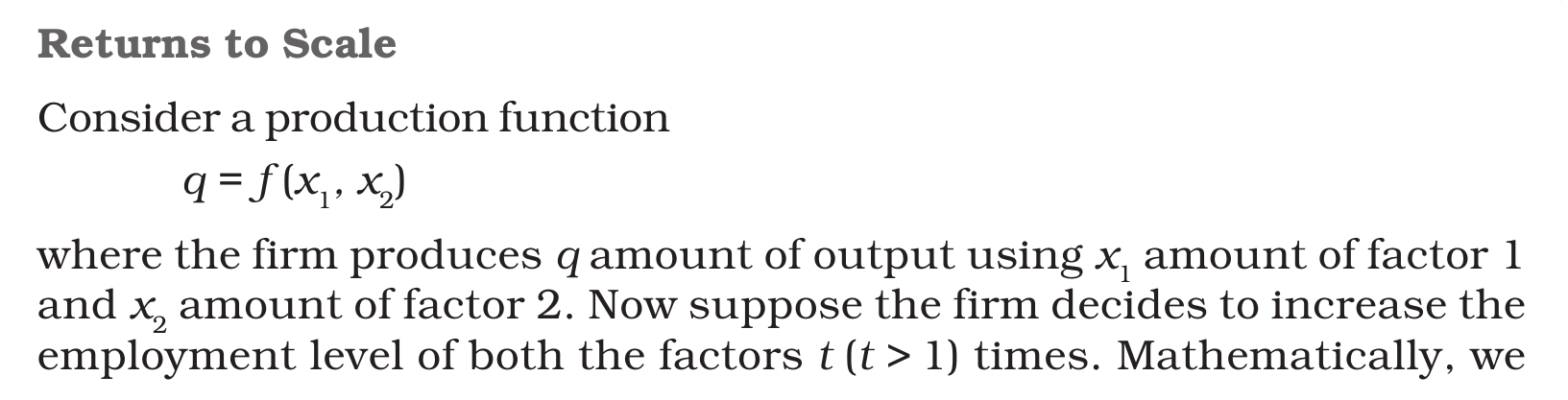
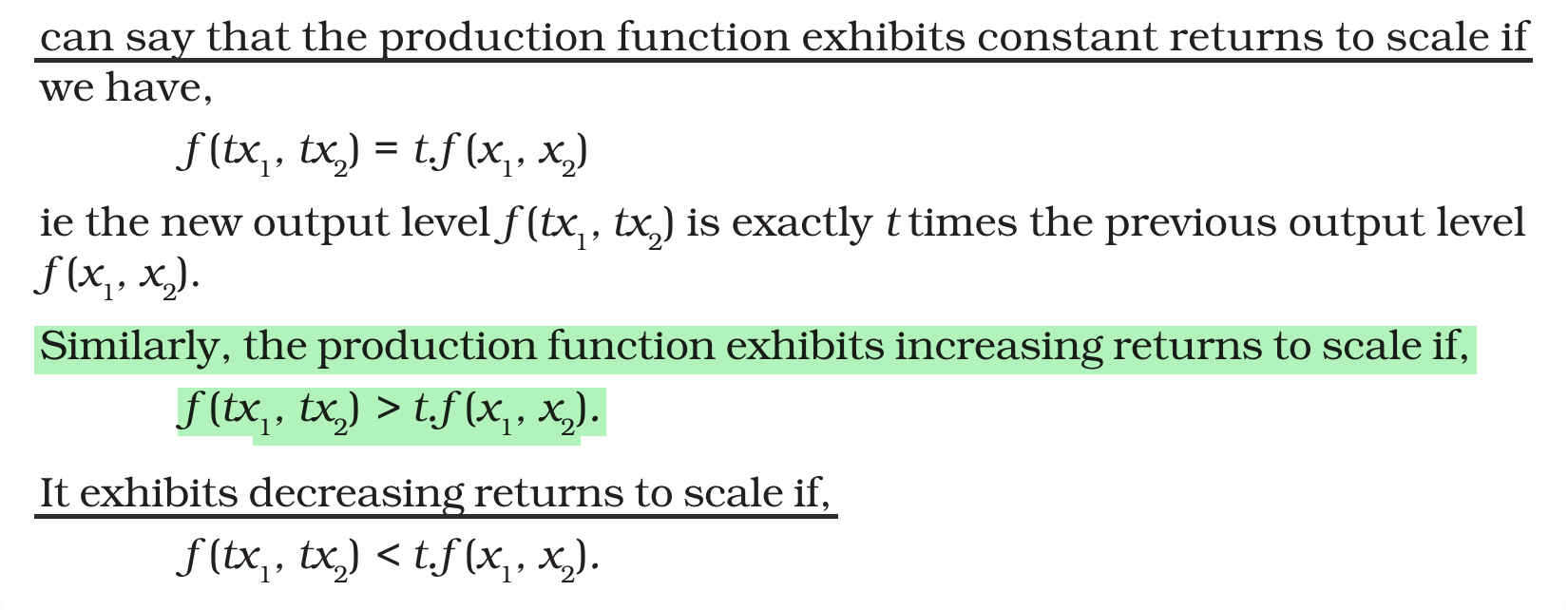
Here all inputs are multiplied by t, and output rises by more than t times. This is increasing returns to scale.
Option (1) Increasing returns to scale. — Correct. \( f(tx_1, tx_2) > t.f(x_1, x_2) \): output rises by a larger proportion than the inputs.
Option (2) Constant returns to scale. — Incorrect. \( f(tx_1, tx_2) = t.f(x_1, x_2) \): output rises in the same proportion as the inputs.
Option (3) Decreasing returns to scale. — Incorrect. \( f(tx_1, tx_2) < t.f(x_1, x_2) \): output rises by a smaller proportion than the inputs.
Option (4) Returns to scale. — Incorrect. This is the general name for how output responds when all inputs are raised in the same proportion. The three cases above are its kinds, and the expression points to one of them.
NCERT (2026-27): Introductory Microeconomics — Chapter 3: Production and Costs
|